What follows is the first in a series of attempts to transcribe in, real time, the institutions that dominate civil (and uncivil) society in the United States, in the first half of 2008. The breeze of history, it seems, has begun to stir again, as one political and social front displaces another, and so the recording must begin in earnest.
"2008 wants open-source art."
A bold statement, perhaps. And yet despite the high-minded academic attitude those of us who grew up before the internet was an afterthought (the "I still like a real newspaper" crew), in 2008 the printed word is becoming obsolete. The newspaper business, once in the most powerful position in private-sector American, is on the ropes, choking to death on slack circulation, decreasing readership, and lackluster advertising revenue. In 2008, as private liquidity deteriorates, many of the major conglomerates will find it increasingly hard to prosper in a rapidly changing market. The current stirrings at CBS, the recent News Corp. takeover, and the long-standing massacre of local radio will all continue to suffer as time marches by. You can bank on it, because everyone under the age of 15 is already better at the internet than you. You probably didn't even know it was a competition.
2008 wants open source art. Imagine what 2018 might want! To even describe the state of the media reveals how much it has changed; we must begin by redefining the term itself. No longer the static, printed, painted word; media has become an inclusive, organic, dynamic word. Media now lives up to its broadest sense: "the production of intellectual capital," or "the tangible expression of thought or feeling," or maybe even "the cultivation of human impulse." Those are now the only rules. Newspapers, magazines, television - are trying to adjust to this shift in audience personality, and trying hard. Live commenting on online editions, featured blogs like NYTimes' DotEarth and The Lede , and mini-slide show integration are only a few of the examples. These techniques are useful and entertaining, and provide excellent information. Most of them are simple and appear cleanly on the page providing ease-of-operation and a continuous aesthetic. But their success is also their failure. It's not as though readership has demanded more information from the newspaper because they can't find it themselves; in fact, the attitude is reversed. Readers demand information because they already have it. In other words, the NY Times finds itself competing with every local blogger on the internet - and with the exception of precious few stories, rarely reporting information the little guy can't.
What's more, the blogosphere and other new media outlets like YouTube, Flikr, and even Facebook now provide instant access to a thousand perspectives, not just a single account. Unlike the 20th century, 2008 has taken back the monopoly on truth. The claim to be made for newspapers, radio, and to a lesser extent, broadcast television, is that they still bear the burden of reporting only the News, capital N - that professional, unbiased, objective reporting we love to think of as a true American icon. 2008 has said both "good night" and "good luck" to that sort of thing, and instead of a single boiled down truth Americans are choosing the human mosaic instead, a digital rendering of our cultural promiscuity splattered across the internet. In the world of webcams, video phones, and the ubiquitous blog, the universality of the newspaper, once its claim to fame, becomes conformity in the minds of a multi-media, user-driven generation.
We have 3G cell phones, full featured iPhones, and a new Google interface that is likely to shift the mobile information market another 90 degrees or so. We have bandwidth auctions, the conversion to all-digital broadcast, and the are on the cusp of blanket wireless internet access. In twenty years, it is likely that every kid in the world will have instant, handheld access to the exact same information at the exact same time. Globalization has its failures, but this exponential expansion of opportunities for human-to-human contact is certainly not one of them.
The traditional media in 2008 is alive, if not well. Newspapers and radio are adjusting, slowly, but the outlook is grim. How does an American-based NYTimes compete with a global Yahoo! News? How does an independent radio station compete with internet streams, Aires, and Pandora? How does TV and film keep up with iTunes? How do small NPR stations compete with free podcasts? How does Playboy compete with YouPorn? Only time will tell, but you can be sure that tomorrow's kids won't want last second's news, let alone yesterday's paper.
Monday, April 14, 2008

Friday, March 7, 2008
An Anonymous Candidate Named Barack Obama
It's time to get ready.
2008 is full upon us - surveillance, campaigns, mudslinging, recession, war, global warming, terror in Gaza, Euros, and the Death Gasp of the Terror Presidency.
Framework: Election
Record crowds are turning out to vote in Democratic primaries for a white woman and a black man, the Republicans have chosen a candidate who doesn't strike morbid fear into the hearts of moderates. We might, it seems, have the makings of a legitimate election on our hands, might just maybe end up with a functioning government that represents the populace from whom its power is derived.Amazing.
But before jumping to such a rosy depiction of 2008, let's remember that George Bush is still in office, and who knows what kind of new policy loopholes he'll enact as a lame duck. One would hardly be surprised if the traditional role of peacemaker is replaced by 9 months of continuous dismantling of the executive branch's accountability. We've already seen the bullying of Congress, the gutting of federal agencies like FEMA and the EPA, a mockery made of the Budget process, and the partisan siege of the Department of Justice. Before the year is over, we could see liberal internment camps, drilling in Yellowstone, and tax credits for personal 18-wheelers. At this point, anything's possible.
November does promise a change in management, however, and if it isn't the political equivalent of Mother Teresa replacing Adolf Hitler, (even Obama isn't a saint...yet), the result will be something like jumping from boiling water to warm bathtub. We will not be able to avoid the impending doom of an economy that is in desperate need of a major attitude adjustment. Markets are going to wither and close to American dollars, the China juggernaut will continue to churn, and the Euro is beginning to look like the best vehicle for international investment. Make no doubt about it, however idealistic the next president may be, there are serious problems that will require techniques as serious and sophisticated as they are idealistic and visionary. There are giants about us in the political world, and we have skeletons in the closet that go back nearly a century. The American Empire is face to face with its day of reckoning, and will fall on the shoulders of the next president to codify the legacy of this country's one great century.
A war rages on that is transparent and seems juvenile in 2008, a small bandaid pasted on a hotspot of widespread insurrection. There is an awakening of global realities and a burgeoning consensus that 20th century means of domination and subjugation must become obsolete if we are to avoid collective collapse, socially and environmentally as well as economically and politically. The next president will be unable to prevent this collapse alone, but he or she must at least begin to address these challenges in ways that are constructive, inclusive, and reflective of global realities.
There are a few concrete "must-do" items waiting on the desk in the Oval Office for whoever the duty falls upon:
- Sign a multi-national agreement on GHG emissions that includes a provisional goal of 50% reduction by 2050 by the United States. And mean it.
- Cut the D.O.D. budget by 20% across the board. Start at the top.
- Create an effective, efficient, and enforceable immigration policy that allows foreign workers to arrive with dignity and remembers that the United States evicted millions of indigenous peoples in its quest for North American dominance.
- Fix health care, at least for children, the elderly, and our veterans. Believe it or not, these groups are the cream of the crop; it's time we remembered to treat them as such. And ban television advertisements for prescription drugs; they serve only to artificially inflate prices.
- Make gay marriage, marijuana possession under 1oz., and jaywalking legal. Raise the driving age to 17 nationwide.
- Make college education tax deductable and set a federal limit on student loan interest rates at 6%.
- Begin the process of drafting a comprehensive debt-reduction strategy that addresses the rampant abuse of consumer credit as well as our national financial quagmire.
This is, obviously, a beginning. Many of these reforms and policy guidelines are, at best, piecemeal. But in order to do positive work in his or her term(s), the next president must understand that the American political machine is a slow-moving behemoth in a lighting quick world. He or she must constantly approach the process with the realization that radical suggestions become moderate policies. So let's pick someone with the experience that counts: the experience to know that hopeful rhetoric and audacious tactics may run the risk of being called naive, but they are often the necessary to effect even slight changes in course. A degree or two to the left in 2008 may eventually result in twenty or thirty degrees in as may years, just as the Reagan administration plotted the neo-con course that's lasted since the mid-1980s. This is a turning point; a vertex of political balance that has consequences for the entire world. Choose accordingly. Choose Obama.
2008 is full upon us - surveillance, campaigns, mudslinging, recession, war, global warming, terror in Gaza, Euros, and the Death Gasp of the Terror Presidency.
Framework: Election
Record crowds are turning out to vote in Democratic primaries for a white woman and a black man, the Republicans have chosen a candidate who doesn't strike morbid fear into the hearts of moderates. We might, it seems, have the makings of a legitimate election on our hands, might just maybe end up with a functioning government that represents the populace from whom its power is derived.Amazing.
But before jumping to such a rosy depiction of 2008, let's remember that George Bush is still in office, and who knows what kind of new policy loopholes he'll enact as a lame duck. One would hardly be surprised if the traditional role of peacemaker is replaced by 9 months of continuous dismantling of the executive branch's accountability. We've already seen the bullying of Congress, the gutting of federal agencies like FEMA and the EPA, a mockery made of the Budget process, and the partisan siege of the Department of Justice. Before the year is over, we could see liberal internment camps, drilling in Yellowstone, and tax credits for personal 18-wheelers. At this point, anything's possible.
November does promise a change in management, however, and if it isn't the political equivalent of Mother Teresa replacing Adolf Hitler, (even Obama isn't a saint...yet), the result will be something like jumping from boiling water to warm bathtub. We will not be able to avoid the impending doom of an economy that is in desperate need of a major attitude adjustment. Markets are going to wither and close to American dollars, the China juggernaut will continue to churn, and the Euro is beginning to look like the best vehicle for international investment. Make no doubt about it, however idealistic the next president may be, there are serious problems that will require techniques as serious and sophisticated as they are idealistic and visionary. There are giants about us in the political world, and we have skeletons in the closet that go back nearly a century. The American Empire is face to face with its day of reckoning, and will fall on the shoulders of the next president to codify the legacy of this country's one great century.
A war rages on that is transparent and seems juvenile in 2008, a small bandaid pasted on a hotspot of widespread insurrection. There is an awakening of global realities and a burgeoning consensus that 20th century means of domination and subjugation must become obsolete if we are to avoid collective collapse, socially and environmentally as well as economically and politically. The next president will be unable to prevent this collapse alone, but he or she must at least begin to address these challenges in ways that are constructive, inclusive, and reflective of global realities.
There are a few concrete "must-do" items waiting on the desk in the Oval Office for whoever the duty falls upon:
- Sign a multi-national agreement on GHG emissions that includes a provisional goal of 50% reduction by 2050 by the United States. And mean it.
- Cut the D.O.D. budget by 20% across the board. Start at the top.
- Create an effective, efficient, and enforceable immigration policy that allows foreign workers to arrive with dignity and remembers that the United States evicted millions of indigenous peoples in its quest for North American dominance.
- Fix health care, at least for children, the elderly, and our veterans. Believe it or not, these groups are the cream of the crop; it's time we remembered to treat them as such. And ban television advertisements for prescription drugs; they serve only to artificially inflate prices.
- Make gay marriage, marijuana possession under 1oz., and jaywalking legal. Raise the driving age to 17 nationwide.
- Make college education tax deductable and set a federal limit on student loan interest rates at 6%.
- Begin the process of drafting a comprehensive debt-reduction strategy that addresses the rampant abuse of consumer credit as well as our national financial quagmire.
This is, obviously, a beginning. Many of these reforms and policy guidelines are, at best, piecemeal. But in order to do positive work in his or her term(s), the next president must understand that the American political machine is a slow-moving behemoth in a lighting quick world. He or she must constantly approach the process with the realization that radical suggestions become moderate policies. So let's pick someone with the experience that counts: the experience to know that hopeful rhetoric and audacious tactics may run the risk of being called naive, but they are often the necessary to effect even slight changes in course. A degree or two to the left in 2008 may eventually result in twenty or thirty degrees in as may years, just as the Reagan administration plotted the neo-con course that's lasted since the mid-1980s. This is a turning point; a vertex of political balance that has consequences for the entire world. Choose accordingly. Choose Obama.
Sunday, December 16, 2007
Wandering Found
I left the dorms at a jog, quietly letting each foot fall to the pavement as it chose, not rushing the strides or their pace. The air was cool and sharp, free from the humidity of summertime and still resisting the bite of early winter breezes. The sun had begun its fall - its fall fall that is - an early, sort of sideways jaunt toward the horizon that seems to be going away for hours - but would sustain the shadows and their chill for a few more hours. I could not run the loop today. I would not run the loop today.
I turned down Commonwealth Avenue instead, preferring the beat of the moving world, its car horns and train screeches, cell phone rings and laughter to the strange pseudo-nature of the reservoir. The pace was determining itself, and I began to look around. People moved back and forth to school, the traffic moved in spurts of red and green behind me, the urbanized wildlife chittered in the trees. Tiles of pavement passed beneath me, concrete dotted with iron, the covers of the inner workings of the material world. Lightposts towered above me, wires lined the streets. And as I passed, I was most likely picked up on the security cameras of several different dwellings and businesses, a moving blur captured forever in static motion, in that one second of passing, like a ghost image in an under-developed photograph.
Down past the intersection, which I avoided, cutting across the marked lanes of the road and dodging delivery trucks, flashers on in that great, semi-acceptable gesture of double-parking we New Englanders love the most and hate the worst. A matter of perception, point of view, and time until the liquor store closes. Down beacon street, left side for a block. Within half a mile of the Circle the housing gets expensive. The feet keep moving, still of their own accord, and the light that filters down through the barely green trees reflected off my sunglasses and bathed my eyes in the glowing amber of late afternoon. I crossed the street, newly paved and lined, the thick black pavement unaffected by its first winter, the granite sidewalks not yet subjected to their first early November frost heave. Across the train tracks. One way.
The first row of apartments quickly give way to the hidden Eden of residential Boston, the gems just off the street that could be placed in middle American suburbia if not for their price tags and cordoned yards. The cars lined along the side look out of place in this more pastoral environment, the large ones even more so. Who lives here? I see a young mother pulling a stroller out the front door of a home on the left - a modest home, with light blue trim and a small but well-maintained garden posted up before the front windows, a model of Renaissance symmetry transplanted 500 years. An older gentleman in a grey suit, trousers hemmed high in the style of the recent past, bowler cocked on his head in the style of the not so recent past. He walked, as I ran, in the dead center of the street, and we moved slightly to our respective right hands as we passed, exchanging a brief, cordial head nod. We were, on foot, both an affront to the motor vehicle-centric infrastructure on which we travelled, and I suspect we both did it for the same reasons - because on this sunny day we could.
The street came to dead end and I looked for a way out, legs still pumping alternately and aloof below me. Cutting through a park, I passed a couple playing tennis, another couple walking slowly with their groceries, she with a beautiful red and gold cloth covering her head and he with a subtle black yarmulkah carefully placed upon his salt and pepper hair. Climbing the stairs on the far side of the park two young black men coach and instruct a group of youngsters in an after-school program, hopping up the hill like frogs. The top of the stairs brought more fresh pavement and yellow-white lines, a new set of stoplights, and the general pervasiveness of high-end autos. I crossed the street onto Beaconsfield road, a winding, traffic-less, residential street with homes that towered above on the left and fell off below to the right. I could be anywhere, I thought, and find a road like this. A small Vermont town might have a small cabin like the one beside me, the tall Victorian ahead could be stamped on a corner in Indiana, the split level ranch coming up on my right stood somewhere next to its brethren in the heart of Pennsylvania or Ohio, and the saltbox 1950's pre-fab was a clear refugee from the West coast suburbs that dotted California, Arizona, and New Mexico. But this was Boston, and the clank of my right foot on a sewer lid reminded me of the municipal system that lay beneath and above the pavements.
Three more miles down, as the crow flies, and I'd be in Roxbury, running through abandoned lots, fast food restaurants, bodegas, and tenement housing. I turned left, up and away from the city proper and chugged up a small hill to the street that would lead me back to the black arteries of asphalt that tied all to the center, converging on the crotch of the system, the Pike/93 confluence, South Station, Government Center. All of the major roads lead here, find some intrinsic connection to the movement of goods and services and labor. But between them, in the gaps between the restraining belts of Beacon and Commonwealth and Boylston, were myriad twisting, turning, poorly paved streets and convoluted infrastructures. You can get lost in these strange conflations of one-ways and cul-de-sacs, cut-throughs and alleys, parking lots that work as streets and vice-versa. I recommend it. To be turned around in a city, bounded by thoroughfares and abandoned by street signs, is a remarkable experience, and a valuable one.
There is a direction to the madness, a general understanding on my part that I know where I am going and where I will end up. But the path is uncertain, and by no linear means will I arrive back at the starting point. These uphill, downhill, curving stretches of road, now turning through the residential alcove that hides between Beacon and Commonwealth, will guide me back through this maze of sunlight and green air, back to those places I know well, taking me back in memory even as they take me forward in the present. The feet keep moving, the pace is fine, and though the chest heaves higher and further from rest there is catharsis to this movement, the energy I've consumed coming back to me in fluid motion - left, right, left. Up on my right there is a gingerbread house with frill yellow trim set against a sky blue exterior and a bright red door. And on the steps of this 18th century Victorian are two kids, both in jeans and skeakers, both sporting Red Sox hats, one over his tight-cropped, curly black hair and deep skin, the other over blond swatches and freckles. The sun sees them both the same, they see each other as peers, and luckily, on this afternoon, no one else sees them at all. Two massive oak trees mark the corner of the block and cast shadows over the stop sign in diagonal relief. I turn right, onto the sidewalk for a moment until the traffic clears and I run sideways across the lines, white then yellow yellow and white again, off the next side street and up, sloping, towards the backside of Comm Ave.
The streets get even dicier here, and I find myself tangled in a maze of parking Do's and Do Not's, mangled in the concrete and steel infrastructure of ill-planned condo complexes and one-way driveways that lead to nowhere. A block further and the image of the VIctorian with its artistic aesthetic, gated yard, and flora is gone altogether. Bricks dominate my view, perched in staggered row after row to form massive square boxes with glass portholes to keep the prisoners' hope alive. I can't make out who might live here, or how they found this place to live, or decided that this was what their life would be. And I can't tell for sure that I won't be in a similar situation in the months to come, untethered, lost between the selves I knew very well at one time and the self I am beginning to understand anew with each block and each step and each passing minute. I am here, actively, and yet here passively, too - caught once again in the intersections of time-space and thought-memory, doomed to overanalyze even as I move with the most concrete motion. Up, down, up, down. Left, right. Left.
And I come up between two buildings, pass a cable company van and a screaming cab driver, wind passing over my ears, bringing the sounds rushing to the center of my brain and me rushing back to the center of this sensory, sensational experience. Just a run on a Tuesday afternoon in Boston. Just the movement of my feet on the pavement, trapesing through the turbulent middle of a city without a center. I can hear the first clicks and turns of the T, the medieval screech of an outdated transportation system whose convoluted design barely outpaces the spiderweb of pavements, some named and some not, that constitute a quaintly archaic infrastructure. There is no method to the madness other than madness itself, and yet as I dodge Range Rovers and Priuses hauling ass on the backs of fossil fuels I am comforted by the ability to make journeys of un-straight lines that still lead me back to the known world. And I am convinced, once again, that there is an appreciable difference between being lost and not knowing where you are going. I am going forward, and sideways, and backward all at once, but there is only one motion involved, the simple corporeal stepping of my feet beneath me and my heart within me. So I will take these tools to be my own as I skip past South St, a place I once knew well that has forgotten me now. And I cross the train tracks a last time as the confines of the campus coming running towards me even as I remain running away from them, a mere flash in the time-space ether away from leaving them altogether. Busses pass me, fences hem me, the road is straight and wide, and my feet continue to move deliberately underneath me, supporting the motion of limbs and mind, the exercise of vision and thinking and hearing and being, all at once, twisting and turning through a world of lost souls and broken hearts. There is only the light that still comes down green through the trees, the angle growing flatter with passing minutes, the sound of shoes on the pavement, left, right, left. Right. And the chest heaves in recognition of the beginning, as if just now feeling the collective weight of trip and telling the body and the mind to stop, STOP, stop. Lost in one place, found in all the others.
I turned down Commonwealth Avenue instead, preferring the beat of the moving world, its car horns and train screeches, cell phone rings and laughter to the strange pseudo-nature of the reservoir. The pace was determining itself, and I began to look around. People moved back and forth to school, the traffic moved in spurts of red and green behind me, the urbanized wildlife chittered in the trees. Tiles of pavement passed beneath me, concrete dotted with iron, the covers of the inner workings of the material world. Lightposts towered above me, wires lined the streets. And as I passed, I was most likely picked up on the security cameras of several different dwellings and businesses, a moving blur captured forever in static motion, in that one second of passing, like a ghost image in an under-developed photograph.
Down past the intersection, which I avoided, cutting across the marked lanes of the road and dodging delivery trucks, flashers on in that great, semi-acceptable gesture of double-parking we New Englanders love the most and hate the worst. A matter of perception, point of view, and time until the liquor store closes. Down beacon street, left side for a block. Within half a mile of the Circle the housing gets expensive. The feet keep moving, still of their own accord, and the light that filters down through the barely green trees reflected off my sunglasses and bathed my eyes in the glowing amber of late afternoon. I crossed the street, newly paved and lined, the thick black pavement unaffected by its first winter, the granite sidewalks not yet subjected to their first early November frost heave. Across the train tracks. One way.
The first row of apartments quickly give way to the hidden Eden of residential Boston, the gems just off the street that could be placed in middle American suburbia if not for their price tags and cordoned yards. The cars lined along the side look out of place in this more pastoral environment, the large ones even more so. Who lives here? I see a young mother pulling a stroller out the front door of a home on the left - a modest home, with light blue trim and a small but well-maintained garden posted up before the front windows, a model of Renaissance symmetry transplanted 500 years. An older gentleman in a grey suit, trousers hemmed high in the style of the recent past, bowler cocked on his head in the style of the not so recent past. He walked, as I ran, in the dead center of the street, and we moved slightly to our respective right hands as we passed, exchanging a brief, cordial head nod. We were, on foot, both an affront to the motor vehicle-centric infrastructure on which we travelled, and I suspect we both did it for the same reasons - because on this sunny day we could.
The street came to dead end and I looked for a way out, legs still pumping alternately and aloof below me. Cutting through a park, I passed a couple playing tennis, another couple walking slowly with their groceries, she with a beautiful red and gold cloth covering her head and he with a subtle black yarmulkah carefully placed upon his salt and pepper hair. Climbing the stairs on the far side of the park two young black men coach and instruct a group of youngsters in an after-school program, hopping up the hill like frogs. The top of the stairs brought more fresh pavement and yellow-white lines, a new set of stoplights, and the general pervasiveness of high-end autos. I crossed the street onto Beaconsfield road, a winding, traffic-less, residential street with homes that towered above on the left and fell off below to the right. I could be anywhere, I thought, and find a road like this. A small Vermont town might have a small cabin like the one beside me, the tall Victorian ahead could be stamped on a corner in Indiana, the split level ranch coming up on my right stood somewhere next to its brethren in the heart of Pennsylvania or Ohio, and the saltbox 1950's pre-fab was a clear refugee from the West coast suburbs that dotted California, Arizona, and New Mexico. But this was Boston, and the clank of my right foot on a sewer lid reminded me of the municipal system that lay beneath and above the pavements.
Three more miles down, as the crow flies, and I'd be in Roxbury, running through abandoned lots, fast food restaurants, bodegas, and tenement housing. I turned left, up and away from the city proper and chugged up a small hill to the street that would lead me back to the black arteries of asphalt that tied all to the center, converging on the crotch of the system, the Pike/93 confluence, South Station, Government Center. All of the major roads lead here, find some intrinsic connection to the movement of goods and services and labor. But between them, in the gaps between the restraining belts of Beacon and Commonwealth and Boylston, were myriad twisting, turning, poorly paved streets and convoluted infrastructures. You can get lost in these strange conflations of one-ways and cul-de-sacs, cut-throughs and alleys, parking lots that work as streets and vice-versa. I recommend it. To be turned around in a city, bounded by thoroughfares and abandoned by street signs, is a remarkable experience, and a valuable one.
There is a direction to the madness, a general understanding on my part that I know where I am going and where I will end up. But the path is uncertain, and by no linear means will I arrive back at the starting point. These uphill, downhill, curving stretches of road, now turning through the residential alcove that hides between Beacon and Commonwealth, will guide me back through this maze of sunlight and green air, back to those places I know well, taking me back in memory even as they take me forward in the present. The feet keep moving, the pace is fine, and though the chest heaves higher and further from rest there is catharsis to this movement, the energy I've consumed coming back to me in fluid motion - left, right, left. Up on my right there is a gingerbread house with frill yellow trim set against a sky blue exterior and a bright red door. And on the steps of this 18th century Victorian are two kids, both in jeans and skeakers, both sporting Red Sox hats, one over his tight-cropped, curly black hair and deep skin, the other over blond swatches and freckles. The sun sees them both the same, they see each other as peers, and luckily, on this afternoon, no one else sees them at all. Two massive oak trees mark the corner of the block and cast shadows over the stop sign in diagonal relief. I turn right, onto the sidewalk for a moment until the traffic clears and I run sideways across the lines, white then yellow yellow and white again, off the next side street and up, sloping, towards the backside of Comm Ave.
The streets get even dicier here, and I find myself tangled in a maze of parking Do's and Do Not's, mangled in the concrete and steel infrastructure of ill-planned condo complexes and one-way driveways that lead to nowhere. A block further and the image of the VIctorian with its artistic aesthetic, gated yard, and flora is gone altogether. Bricks dominate my view, perched in staggered row after row to form massive square boxes with glass portholes to keep the prisoners' hope alive. I can't make out who might live here, or how they found this place to live, or decided that this was what their life would be. And I can't tell for sure that I won't be in a similar situation in the months to come, untethered, lost between the selves I knew very well at one time and the self I am beginning to understand anew with each block and each step and each passing minute. I am here, actively, and yet here passively, too - caught once again in the intersections of time-space and thought-memory, doomed to overanalyze even as I move with the most concrete motion. Up, down, up, down. Left, right. Left.
And I come up between two buildings, pass a cable company van and a screaming cab driver, wind passing over my ears, bringing the sounds rushing to the center of my brain and me rushing back to the center of this sensory, sensational experience. Just a run on a Tuesday afternoon in Boston. Just the movement of my feet on the pavement, trapesing through the turbulent middle of a city without a center. I can hear the first clicks and turns of the T, the medieval screech of an outdated transportation system whose convoluted design barely outpaces the spiderweb of pavements, some named and some not, that constitute a quaintly archaic infrastructure. There is no method to the madness other than madness itself, and yet as I dodge Range Rovers and Priuses hauling ass on the backs of fossil fuels I am comforted by the ability to make journeys of un-straight lines that still lead me back to the known world. And I am convinced, once again, that there is an appreciable difference between being lost and not knowing where you are going. I am going forward, and sideways, and backward all at once, but there is only one motion involved, the simple corporeal stepping of my feet beneath me and my heart within me. So I will take these tools to be my own as I skip past South St, a place I once knew well that has forgotten me now. And I cross the train tracks a last time as the confines of the campus coming running towards me even as I remain running away from them, a mere flash in the time-space ether away from leaving them altogether. Busses pass me, fences hem me, the road is straight and wide, and my feet continue to move deliberately underneath me, supporting the motion of limbs and mind, the exercise of vision and thinking and hearing and being, all at once, twisting and turning through a world of lost souls and broken hearts. There is only the light that still comes down green through the trees, the angle growing flatter with passing minutes, the sound of shoes on the pavement, left, right, left. Right. And the chest heaves in recognition of the beginning, as if just now feeling the collective weight of trip and telling the body and the mind to stop, STOP, stop. Lost in one place, found in all the others.
Running on Fumes
As we march deliberately into the end of the era of the United States as hegemonic world power like so many lemmings over the edge of a cliff, the government and the rich people keep telling us that nothing is wrong. For most people, that's enough.
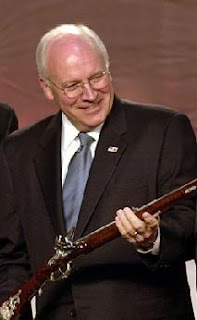
Since the abandonment of the gold standard during the era of New Deal reforms, the economy has been slipping steadily into an insurmountable hole, or debt and write-downs and outsourcing that is beginning to catch up with us. And we stand now poised at the precipice of a collapsing world financial infrastructure, looking straight down the barrel of a gun loaded with international fiscal ruin - and with Dick Cheney behind the sights that's a dangerous proposition. As far as I'm concerned, it might be the best thing that happens to humanity in my lifetime.
The steadily increasing national debt, now standing around $9 trillion is only the least of our problems. The concept itself is a quagmire, explainable only in jumbled economic jargon and a long discussion about modern monetary theory. But strip off all the bullshit and the idea is simple: we're using money that only kinda sorta actually exists on a material basis. And we're using lots and lots and lots of it. Since the advent of the Reagan revolution we've been trapped in a continuous reaffirmation of Keynesian insanity - the notion that supply-side economics was ever going to work is interminably couched in a system of privilege and inequality that knows no bounds. Giving to the poor by giving to the rich? Seriously?
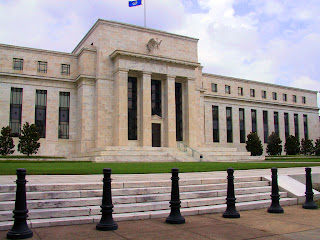
In the meantime, we've deregulated almost every industry, gutted the environmental reforms of the 1970s (which made us then, unlike now, a world leader on the subject), corporatized the media, opened the revolving door between Washington, K Street lobbies, interest groups, and the private sector, ruined Social Security and subverted the Health Care system, made a mockery of mental health and veterans benefits, clamped down on immigration while opening loopholes for immigrants' exploitation, and gotten to the point where the President can hand out military contracts to his buddies in the context of an un-endable, un-winnable, extremely profitable war. I think we're doing terribly, to be honest.

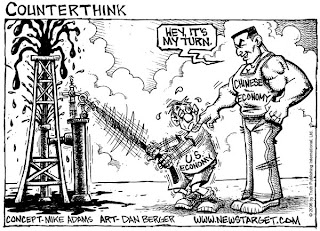
Add to this the fact that even the most astutely realist political scientists agree on the fact that China's economy will be larger than ours in the next fifty years and the fact that we currently operate on a 300 million dollar-a-year trade deficit with that country and the picture gets grimmer. India isn't far behind. What's left is an America trying to retain the world heavyweight belt by force instead of retiring gracefully and changing the nature of the sport. It's like we have the choice to be Ali or Tyson and instead of thinking it over we've bitten off the ears of everyone who even sniffs in our direction the wrong way. Instead of stepping down and encouraging mutual competition, we are the bully who has been outnumbered and continues to talk shit. And we all know what happens to that guy.
If we could only stop now and try to mend the mistakes of the past instead of rewriting the Monroe doctrine and stealing from third world countries in a last ditch attempt to line our pockets we might realize that there is something altogether more important at stake than being the world's strongest nation-state: being the world's smartest. Aside from the fact that kids in America are, on average, dumber and fatter than their European, Australian, and South American counterparts (do a little looking on this), the country as a whole is missing a great opportunity to use the last gasp of our cultural influence (America as a culture is still cool, apparently) to create a worldwide movement of tolerance and subsistence instead of division and consumption, we might just manage to tip the scales back to neutral, especially on the environmental question.

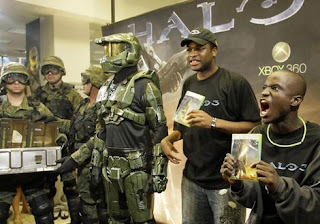
The nature of international politics, as any PoliSci professor over 50 will tell you, is anarchic, unpredictable and violent. But this assumes that politics and the international system have some specific nature that dictates them instead of realizing that the whole fucking discipline is less than a few hundred years old and that a lot has changed even in the last 20 years. Imagine an international politics that involves white kids and brown kids thousands of miles away playing the same videogames on a worldwide invisible network, talking to each other in real time as they interact in a virtual world. Fuck anarchic, this shit is incredible. In the context of a world where that goes on everyday, telling me that we didn't sign Kyoto because of differences in linguistic understanding and policy restrictions is a slap in the face. Why won't we act like normal human beings that live in a finite world for once? This is our children's future.
The simple answer is deafening and silencing at once, and it crushes the spirit of those of us who see more clearly (or perhaps more vaguely). The simple answer is that a few people are making a lot of money, and they don't want to stop making that much money. And what's worse, they can't be blamed. They live in a system that constantly requires them to preform a simple and never-ending task - make more money. And he we stand, faced with the realization that the system we live in is fundamentally opposed to our material reality, a reality that includes a dwindling oil supply, a skyrocketing debt, a mortgage and credit crisis, rampant poverty and unemployment, and a planet that is screaming at the top of its poisoned lungs for us to slow the fuck down. But the engines of the system are churning along full tilt, all cylinders firing, churning liquid capital out of the earth as the economy sucks in fresh dollars out of thin air.
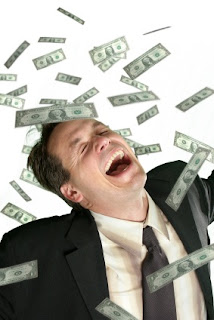
Simple physics tells us that combustion engines need three things: fuel, air, and ignition. The system has plenty of sparks to go around - nationalism, the American dream, stuff upon stuff upon stuff. But what happens with the oil runs out and the mystical, airborne mint breathes its last dollar bill? We all seem to know the answer, somewhere between our hearts and our stomachs, and yet we remain defiant, our foot stamped on the accelerator as we grind down the gearbox, doing 95 in a 60 in 3rd gear. I hope we have the sense to hit the brakes before its too late. But right now, it looks like I'd better get ready to tuck and roll.
Since the abandonment of the gold standard during the era of New Deal reforms, the economy has been slipping steadily into an insurmountable hole, or debt and write-downs and outsourcing that is beginning to catch up with us. And we stand now poised at the precipice of a collapsing world financial infrastructure, looking straight down the barrel of a gun loaded with international fiscal ruin - and with Dick Cheney behind the sights that's a dangerous proposition. As far as I'm concerned, it might be the best thing that happens to humanity in my lifetime.

The steadily increasing national debt, now standing around $9 trillion is only the least of our problems. The concept itself is a quagmire, explainable only in jumbled economic jargon and a long discussion about modern monetary theory. But strip off all the bullshit and the idea is simple: we're using money that only kinda sorta actually exists on a material basis. And we're using lots and lots and lots of it. Since the advent of the Reagan revolution we've been trapped in a continuous reaffirmation of Keynesian insanity - the notion that supply-side economics was ever going to work is interminably couched in a system of privilege and inequality that knows no bounds. Giving to the poor by giving to the rich? Seriously?

In the meantime, we've deregulated almost every industry, gutted the environmental reforms of the 1970s (which made us then, unlike now, a world leader on the subject), corporatized the media, opened the revolving door between Washington, K Street lobbies, interest groups, and the private sector, ruined Social Security and subverted the Health Care system, made a mockery of mental health and veterans benefits, clamped down on immigration while opening loopholes for immigrants' exploitation, and gotten to the point where the President can hand out military contracts to his buddies in the context of an un-endable, un-winnable, extremely profitable war. I think we're doing terribly, to be honest.

Add to this the fact that even the most astutely realist political scientists agree on the fact that China's economy will be larger than ours in the next fifty years and the fact that we currently operate on a 300 million dollar-a-year trade deficit with that country and the picture gets grimmer. India isn't far behind. What's left is an America trying to retain the world heavyweight belt by force instead of retiring gracefully and changing the nature of the sport. It's like we have the choice to be Ali or Tyson and instead of thinking it over we've bitten off the ears of everyone who even sniffs in our direction the wrong way. Instead of stepping down and encouraging mutual competition, we are the bully who has been outnumbered and continues to talk shit. And we all know what happens to that guy.

If we could only stop now and try to mend the mistakes of the past instead of rewriting the Monroe doctrine and stealing from third world countries in a last ditch attempt to line our pockets we might realize that there is something altogether more important at stake than being the world's strongest nation-state: being the world's smartest. Aside from the fact that kids in America are, on average, dumber and fatter than their European, Australian, and South American counterparts (do a little looking on this), the country as a whole is missing a great opportunity to use the last gasp of our cultural influence (America as a culture is still cool, apparently) to create a worldwide movement of tolerance and subsistence instead of division and consumption, we might just manage to tip the scales back to neutral, especially on the environmental question.

The nature of international politics, as any PoliSci professor over 50 will tell you, is anarchic, unpredictable and violent. But this assumes that politics and the international system have some specific nature that dictates them instead of realizing that the whole fucking discipline is less than a few hundred years old and that a lot has changed even in the last 20 years. Imagine an international politics that involves white kids and brown kids thousands of miles away playing the same videogames on a worldwide invisible network, talking to each other in real time as they interact in a virtual world. Fuck anarchic, this shit is incredible. In the context of a world where that goes on everyday, telling me that we didn't sign Kyoto because of differences in linguistic understanding and policy restrictions is a slap in the face. Why won't we act like normal human beings that live in a finite world for once? This is our children's future.

The simple answer is deafening and silencing at once, and it crushes the spirit of those of us who see more clearly (or perhaps more vaguely). The simple answer is that a few people are making a lot of money, and they don't want to stop making that much money. And what's worse, they can't be blamed. They live in a system that constantly requires them to preform a simple and never-ending task - make more money. And he we stand, faced with the realization that the system we live in is fundamentally opposed to our material reality, a reality that includes a dwindling oil supply, a skyrocketing debt, a mortgage and credit crisis, rampant poverty and unemployment, and a planet that is screaming at the top of its poisoned lungs for us to slow the fuck down. But the engines of the system are churning along full tilt, all cylinders firing, churning liquid capital out of the earth as the economy sucks in fresh dollars out of thin air.

Simple physics tells us that combustion engines need three things: fuel, air, and ignition. The system has plenty of sparks to go around - nationalism, the American dream, stuff upon stuff upon stuff. But what happens with the oil runs out and the mystical, airborne mint breathes its last dollar bill? We all seem to know the answer, somewhere between our hearts and our stomachs, and yet we remain defiant, our foot stamped on the accelerator as we grind down the gearbox, doing 95 in a 60 in 3rd gear. I hope we have the sense to hit the brakes before its too late. But right now, it looks like I'd better get ready to tuck and roll.
Wednesday, December 12, 2007
Democracy of Misrepresentation
Stop trying to figure out who's going to win the election this year. It doesn't matter.
As of right now, the imperialist swine that dictate campaign finance and strategy (read: Karl Rove) have your nuts in a fucking vicegrip. The democracy has been taken over by the hegemony of propaganda. You no longer control your own destiny.
It may sound like a bit much, but the truth remains: the voters are now, more than ever, a market to be cornered instead of served. Manipulation of media and word wars between Yale-educated system pawns dictate the flow of information, deciding what voters see, hear, think. And while the YouTube debates are certainly a step in the right direction, for the most part we are doomed to live in the blackhole of reliance on mainstream media instead of the golden age of oration. We have little or no idea what any of these candidates will do once in office, and we must realize the limiting factors of the office itself. A President, though influential, cannot change the system.
A bunch of old white guys still make laws for a country that is harly old, or white, or male. The representative democracy the United States has always claimed has always been a democracy of representation - representation of freedom, of wealth, of equality. But on the ground these things take on different guises and meanings, become entirely different things. Tell a businessman in the suburbs he's a free man and he'll tell you he knows; tell a migrant worker in Texas the same thing and he'll scowl at your hubris. Policy and politics and language mean nothing on the ground, and the beat of work and of the sun reminds our worker just how far from Washington he is, and just how far Washington is from him.
The unspoken arrangement of politics in this country is simple: we know better than you. We know the way the world works, we know the how to manipulate it, we know what's best for America. We know because we are white, and male, and rich. We know because we sat in classrooms and listened to people like us. We know because we got jobs working for people like us. And we know because of the money we've made off of people like you.
Make no doubt about it, the power elites understand this relationship. Politicians know that their power is couched in the denial of agency. CEO's know their fortune is couched in the exploitation of labor. And oil companies know their future is couched in the rape of the environment. They understand the way their world works - as a zero sum game. One up means one down, and more often two or three or ten down.
So as you watch this election season, perhaps the most ridiculous of all time, remember that you are a target. You are a consumer, a piece of the market to be cornered and exploited. You are put into groups based on race and gender and class and religion; a demographic and a number and nothing near a human being. Whether you purchase Romney or Clinton or Guiliani or Obama or, God willing, Huckabee, remind yourself that your vote comes at a price. And if you choose to be apathetic, at least do so with passion.
As of right now, the imperialist swine that dictate campaign finance and strategy (read: Karl Rove) have your nuts in a fucking vicegrip. The democracy has been taken over by the hegemony of propaganda. You no longer control your own destiny.
It may sound like a bit much, but the truth remains: the voters are now, more than ever, a market to be cornered instead of served. Manipulation of media and word wars between Yale-educated system pawns dictate the flow of information, deciding what voters see, hear, think. And while the YouTube debates are certainly a step in the right direction, for the most part we are doomed to live in the blackhole of reliance on mainstream media instead of the golden age of oration. We have little or no idea what any of these candidates will do once in office, and we must realize the limiting factors of the office itself. A President, though influential, cannot change the system.
A bunch of old white guys still make laws for a country that is harly old, or white, or male. The representative democracy the United States has always claimed has always been a democracy of representation - representation of freedom, of wealth, of equality. But on the ground these things take on different guises and meanings, become entirely different things. Tell a businessman in the suburbs he's a free man and he'll tell you he knows; tell a migrant worker in Texas the same thing and he'll scowl at your hubris. Policy and politics and language mean nothing on the ground, and the beat of work and of the sun reminds our worker just how far from Washington he is, and just how far Washington is from him.
The unspoken arrangement of politics in this country is simple: we know better than you. We know the way the world works, we know the how to manipulate it, we know what's best for America. We know because we are white, and male, and rich. We know because we sat in classrooms and listened to people like us. We know because we got jobs working for people like us. And we know because of the money we've made off of people like you.
Make no doubt about it, the power elites understand this relationship. Politicians know that their power is couched in the denial of agency. CEO's know their fortune is couched in the exploitation of labor. And oil companies know their future is couched in the rape of the environment. They understand the way their world works - as a zero sum game. One up means one down, and more often two or three or ten down.
So as you watch this election season, perhaps the most ridiculous of all time, remember that you are a target. You are a consumer, a piece of the market to be cornered and exploited. You are put into groups based on race and gender and class and religion; a demographic and a number and nothing near a human being. Whether you purchase Romney or Clinton or Guiliani or Obama or, God willing, Huckabee, remind yourself that your vote comes at a price. And if you choose to be apathetic, at least do so with passion.
Sunday, September 30, 2007
Less Decadent, More Depraved : NASCAR and The Great American Spectacle
So we're allmost out of oil. And carbon emmissions from petroleum burning engines are destroying the environment. But we're America, so we do the only logical thing: we build 800 horsepower, fuel guzzling racecars, and have them chase each other around a glorified hampster wheel for 400 laps at a time. We do it every weekend (3 times every weekend, actually), and 150,000 people come to watch.
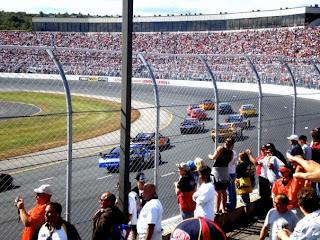
That's three colliseums' worth of people - and the comparison is no mistake. In many ways the NASCAR phenomenon is akin to the spectacles of ancient Rome, spectacles where human life was regularly destroyed in the name of visceral entertainment. While the possibility of death, or at least the anticipation of disastrous high-speed collisions, is certainly a major draw for many fans, the sacrifice in NASCAR comes from the bosom of of Mother Nature. By most accounts, an average NASCAR series season comsumes about 200,000 gallons of fuel. This figure excludes practice, qualifying, and tuning, all of which undoubtedly inflate it considerably. The consumption itself is staggering, to be sure, but the rate at which these machines suck down gas is matched in intensity only by the jet-engine-level noise they throw into the atmosphere. The shit is loud. Really loud. Ears-bleeding, eyeballs-bulging, rib-shaking loud.
In fact, the experience of the racetrack is blistering for all five senses. Not only is your auditory capacity at the complete mercy of these massive, churning dynamos, the smell of burning rubber and Marlboros stuffs your nostrils, the cold, damp touch of a sweating Budweiser can preoccupies he fingers. And then the sights - oh the sights! Jean shorts and flame-tagged hats, no-name hightops and decaled pickups, meth addicts, swingers, smokers, mullets, spare rib and hamburger profilgacy, small children and old ladies, beer bellies and big titties, booze upon booze upon booze upon booze, more booze, a strikingly high number of full families, and a surprisingly low contingent of police. And caucasia everywhere.
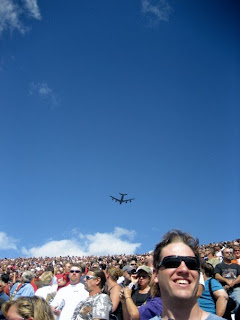
They are 150,000 pilgrims to the high altar of motorsports, and on sunny Sunday sabbaths they trade in church for, as one pre-event prayer read, "racing in the name of Jesus Christ, the way God intended." And for many the spectacle is nothing short of a religious happening. Mom, Dad, and Grandma show up in the RV on Thursday night, watch qualifying, the truck race, the Busch race, and then gear up for the main event, the consecration of the entire ceremony, the culminating act of the whole shebang: the Nextel race.
Nextel races draw, on average, more spectators than for any other major sport in the United States. They command the second position, behind NFL football, in the television ratings battle. And watching a race, either in person or on that magical talking box Americans love so much, one is exposed to unparalleled volume of corporate sponsorship. Alcohol manufacturers, car insurance dealers, office suppliers, home-improvement stores, and even the US National Guard claim primary sponsorship of a Nextel car, a billion dollar a year commitment. Their logos displayed prominently on all sides of the vehicle, creating a permanent, three-hour long TV spot and a mobile billboard at the same time. Merchandise sales routinely top $2 billion annually, everything from model cars to clothing to furniture.

So why do they come? Why do these people tune in and turn out 40 weeks of the year to this fuel-wasting, environment draining, consumerism-inciting spectacle of excess and incest? They do it because the human animal is addicted to entertainment, compelled naturally toward the possibility of destruction, still governed, at some level, by the craving for viceral stimuli. And Goddamn it, dem cars go real fast.

That's three colliseums' worth of people - and the comparison is no mistake. In many ways the NASCAR phenomenon is akin to the spectacles of ancient Rome, spectacles where human life was regularly destroyed in the name of visceral entertainment. While the possibility of death, or at least the anticipation of disastrous high-speed collisions, is certainly a major draw for many fans, the sacrifice in NASCAR comes from the bosom of of Mother Nature. By most accounts, an average NASCAR series season comsumes about 200,000 gallons of fuel. This figure excludes practice, qualifying, and tuning, all of which undoubtedly inflate it considerably. The consumption itself is staggering, to be sure, but the rate at which these machines suck down gas is matched in intensity only by the jet-engine-level noise they throw into the atmosphere. The shit is loud. Really loud. Ears-bleeding, eyeballs-bulging, rib-shaking loud.
In fact, the experience of the racetrack is blistering for all five senses. Not only is your auditory capacity at the complete mercy of these massive, churning dynamos, the smell of burning rubber and Marlboros stuffs your nostrils, the cold, damp touch of a sweating Budweiser can preoccupies he fingers. And then the sights - oh the sights! Jean shorts and flame-tagged hats, no-name hightops and decaled pickups, meth addicts, swingers, smokers, mullets, spare rib and hamburger profilgacy, small children and old ladies, beer bellies and big titties, booze upon booze upon booze upon booze, more booze, a strikingly high number of full families, and a surprisingly low contingent of police. And caucasia everywhere.

They are 150,000 pilgrims to the high altar of motorsports, and on sunny Sunday sabbaths they trade in church for, as one pre-event prayer read, "racing in the name of Jesus Christ, the way God intended." And for many the spectacle is nothing short of a religious happening. Mom, Dad, and Grandma show up in the RV on Thursday night, watch qualifying, the truck race, the Busch race, and then gear up for the main event, the consecration of the entire ceremony, the culminating act of the whole shebang: the Nextel race.
Nextel races draw, on average, more spectators than for any other major sport in the United States. They command the second position, behind NFL football, in the television ratings battle. And watching a race, either in person or on that magical talking box Americans love so much, one is exposed to unparalleled volume of corporate sponsorship. Alcohol manufacturers, car insurance dealers, office suppliers, home-improvement stores, and even the US National Guard claim primary sponsorship of a Nextel car, a billion dollar a year commitment. Their logos displayed prominently on all sides of the vehicle, creating a permanent, three-hour long TV spot and a mobile billboard at the same time. Merchandise sales routinely top $2 billion annually, everything from model cars to clothing to furniture.

So why do they come? Why do these people tune in and turn out 40 weeks of the year to this fuel-wasting, environment draining, consumerism-inciting spectacle of excess and incest? They do it because the human animal is addicted to entertainment, compelled naturally toward the possibility of destruction, still governed, at some level, by the craving for viceral stimuli. And Goddamn it, dem cars go real fast.
Thursday, June 7, 2007
To: Anonymous - From: The Kids
From the kids of the street:
Fuck you nigga.
You heard me.
Fuck you, Nigga.
Wow nigga
how nigga
now nigga
tell me how i'm supposed to rise above the violence and strife
when the smell around me cuts like a knife
when none of the my brothers' fathers call my mother their wife
when the game pins my ambition tight like a vice
tell me how i'm supposed to live my life.
school's out prison's in
it's where i'll find my closest of kin
doin time in the joint for smokin' a joint
mothafuckas i know you got my point man
held up in cuffs like scotland yard
playin' the trump card; rat
me out i'm beggin you please
my homies'll have screamin 'don't' from your knees
just be thankful i'm smokin' those trees
make 5.50 to work, lose 10 from welfare
you do the math like sebastian telfar,
couldn't count the numbers on the fuckin' contract
even if he could make the shot after contact.
so hedge fund your bets trustfunders
and let the system pull me under
pregnant by 15, addicted at 20, dead at 40,
damn sure MY record never made no royalties
still holdin tight in my pocket to my false sense of loyalty
to the streets.
so fuck you nigga.
you heard me.
fuck you, nigga
- the youth
Fuck you nigga.
You heard me.
Fuck you, Nigga.
Wow nigga
how nigga
now nigga
tell me how i'm supposed to rise above the violence and strife
when the smell around me cuts like a knife
when none of the my brothers' fathers call my mother their wife
when the game pins my ambition tight like a vice
tell me how i'm supposed to live my life.
school's out prison's in
it's where i'll find my closest of kin
doin time in the joint for smokin' a joint
mothafuckas i know you got my point man
held up in cuffs like scotland yard
playin' the trump card; rat
me out i'm beggin you please
my homies'll have screamin 'don't' from your knees
just be thankful i'm smokin' those trees
make 5.50 to work, lose 10 from welfare
you do the math like sebastian telfar,
couldn't count the numbers on the fuckin' contract
even if he could make the shot after contact.
so hedge fund your bets trustfunders
and let the system pull me under
pregnant by 15, addicted at 20, dead at 40,
damn sure MY record never made no royalties
still holdin tight in my pocket to my false sense of loyalty
to the streets.
so fuck you nigga.
you heard me.
fuck you, nigga
- the youth
Subscribe to:
Posts (Atom)