General Motors, perhaps the greatest symbol of American manufacturing and business, filed for bankruptcy this morning amid a firestorm of massive debt, union disagreements, federal bailouts and gross mismanagement. A company whose stock was once synonymous with risk-free investing has vanished from the Dow Jones Industrial Average, its shining blue and chrome nameplate now tarnished, hanging crooked above the wreckage of a vacant factory in middle America. In many ways, a bittersweet victory for the grand theory of systemicide.
It seems fitting on this occasion of corporate failure to release to the world the Systemicide principles of un-management: a manifesto of business that casts aside traditional notions of order and hierachy in favor of an organic, natural, and reasonable code of human productivity that reflects a desire to create a happy, sustainable, and hyper-productive workplace.
- Divide the work calendar into manageable chunks.
People like university schedules because they are comprised of finite units with tangible outcomes and a foreseeable ending. Upon completion, they know that they will have sufficient leisure time to recharge their intellectual curiosity, to reflect upon what they have learned, and to celebrate other, often more social, aspects of their lives. This seems to create an environment where people are motivated to produce interesting and useful work, where they can see the rewards of that work, and where those rewards are directly tied to the quality that work. If a student finishes a particularly difficult semester and is rewarded with exemplary marks, the positive reinforcement is immediate and gratifying. The student will take the skills and strategies learned during that semester and identify ways to leverage them toward further success. Conversely, a student whose grades have suffered because of faulty or inefficient strategies is likely to identify the causes of poor performance and work to improve them in the future. This assumes, of course, that the student is interested in receiving the reward of good grades. Though this may not always be the case in a university setting, when we replace academic success in the form of grades with financial success in the form of monetary compensation, we find that the person in question will almost always be interested in the reward.
Why the business community has chosen to abandon this construct in favor of a never-ending cycle of homogeneous toil makes little sense to the manager interested in maximizing the potential and sustainability of his employees' efforts. Just like a university schedule, the business calendar should be divided into manageable chunks with substantial scheduled leisure time between them. While the exact structure of the calendar will undoubtedly vary based on the type of enterprise, the ideal structure is four quarters with at least two weeks of time off between them. While the thought of giving employees eight weeks off will cause most American managers' heads to explode, I'd be willing to bet that such a schedule would yield more productivity than the traditional American schedule. With strategic goals set for each quarter, projects that require completion within specific timeframes, and evaluations at the conclusion of each time chunk, employees are naturally incentivized to work hard, meet deadlines, and care about performance.
- Pay for performance, not time.
This one seems so simple, and yet it may be the most grossly misunderstood principle of productivity. If you pay people for time, the are naturally inclined to work slower. This lowers the effort they need o expend while at the same time increasing the amount of compensation they receive. Creating a system that rewards employees for producing less lowers profits, bores employees, stagnates growth, and stifles innovation.
This doesn't mean that employees need to be paid like contract workers who receive compensation only when they finish a project - that arrangement may encourage employees to rush through projects in order to buy groceries for the week, degrading the quality of the finished product even if more projects are accomplished in a given time. It simply means that you let employees go home when they're done. In almost all work situations, some days are lighter than others. Making employees stay until an arbitrary time won't increase productivity. More often than not, peer pressure will dictate when employees head home anyways. A focused, productive, and efficient day of work should be rewarded with an early dismissal, not penalized by an arbitrary chronology. Creating a culture where work is done in teams will serve to organically eliminate slackers, or at least to highlight their incompetence. When they make themselves visible, under-performers should be fired immediately. No performance, no pay.
- Incentivize ownership and reward success
The more connected people feel to their work, the better their work will be. Whenever possible, give employees the chance to take ownership over a task or project. In particular, allow junior employees to take leadership positions on projects that include senior employees. This serves several distinct purposes. First, it encourages junior employees to work hard because they won't want to appear incompetent in front of their higher-ups. Second, it gives the most talented employees a chance to separate themselves from the pack organically, without the divisive and poisonous effects of traditional hierarchical promotion. Third, it forces managers and senior employees to understand the strengths and weaknesses of junior team members, allows them to leverage their experience at all levels of the organization, and fosters an environment in which everyone, regardless of rank, is continually pushed to improve their skills. Lastly, it allows young, ambitious employees to feel as if every project is a new chance for success. Those who take ownership of projects that turn out to be exceptionally successful should be rewarded financially, optimally with a fixed percentage of revenue generated by their work. Rewarding success with money is important, but the reward must be directly proportional to success. Adherence to that simple rule of bonuses might have saved more than one Wall Street hegemon.
- Don't fight the seasons.
Despite a highly-technical and impeccably-engineered work space, and despite America's insistence on an anti-natural economy, humans are fundamentally affected by the seasons. Daylight savings time was a step in the right direction, but businesses can do even more to reflect these seasonal changes to keep their employees happy and productive. Shifting hours back in the winter time and forward in the summer (say starting at 10:30 in the dead of winter and 6:30 in the heat of summer)makes perfect sense from a physiological standpoint. Before the advent of the industrial revolution, this took place naturally - the sunrise would dictate the start of the work day. Recreating this cycle attaches people to the natural world, allows them to spend daylight hours with their friends and families when the weather is nice, and breaks up the mental drudgery that and monotonous delirium that accompanies most corporate schedules.
The type of work being done can also be segmented by season. Save the more clerical, dense, and grind-it-out tasks for the winter, when distractions are fewer, and utilize the spring and summer months for the more creative, innovative, and hands-on projects. Strategy and planning are best held off until the fall, when the days get shorter and humans are naturally prone to prudence and practicality. The human animal has been around much longer than the modern workplace, so why not change the latter to suit the former, instead of trying to reverse three million years of evolution?
- Engage and leverage your employees' other interests.
This doesn't mean simply encouraging them to read books in their free time, nor does it mean that blatantly unrelated tasks should be tolerated during work. Instead, employees should be prompted to find ways their outside interests can be related to their professional lives. Is World of Warcraft related to Financial Accounting? Probably not. But the expansion of virtual communities like W.O.W. and the market for virtual goods certainly is. How do we calculate inventory of virtual goods? What happens to the cash cycle when no physical product exists? Is computer software an asset, or a cost? And how does one calculate the liability of a flaming lava sword?
Even if they appear unrelated to core products or services, employees' interests can provide new and refreshing contexts within which to explore concepts and ideas that an organization encounters every day. Whether it's W.O.W., whitewater kayaking, knitting, or fiction writing, chances are there's a lesson or mantra that can be applied to whatever business you're in.
Ask employees to think about and look for these connections, however vague they may seem, and encourage them to present these 'case studies' of sorts, to their employees. Aside from getting them to think outside the box, it encourages team bonding and can be a nice way to break up a busy work week. And talking about what makes them happy makes people happy.
- Don't confuse ability with experience.
One is learned, one is innate. It's impossible to say which is more important, and valuable arguments can be made in favor of either. But they are distinct traits to be recognized and separated when possible. In sports, the difference between the two is easy to recognize. Sometimes a young superstar will blaze past an experienced defender on his way to the goal, or the endzone, or the basket. Other times, the experienced defender will take a better angle, or make a craftier play, and nullify the superior ability of his younger counterpart. Millions of examples of both instances exist. The winner is determined by circumstance, the equalizer. In business, the two are sometimes harder to differentiate. Experience can be the key to crafting a successful, stable deal, or finishing a project on time and on budget. Or it can be the blinders that prevent a manager from seeing the new and innovative methods his competitors are employing. Ability can be the incalculable intangible that pushes an stagnant company into the stratosphere, or it can be the hubris than plunges as sustainable one into debt.
The important thing is to realize that past experience doesn't always translate into future success, just as inexperience doesn't necessarily translate into certain failure. As with the sports, the results are largely situational. But remember, ability only gets experience when given the chance.
In retrospect, perhaps GM should have relied a little more on ability and a little less on experience. In the end, reliance on the tried and true formula turned out to be its failure. And as with the banks, it has taken a crisis to get the machine to stop moving long enough to assess its overall health. This is why the system is prone to crisis. Predisposed to catastrophe. Predestined to period failure. The successful and sustainable business of the future must take the time to pump the brakes and change the oil every few months. Just like the natural world in which it exists, it must recognize that seasons come and go, that cycles begin and end, and that value is neither created nor destroyed, but simply changes form.
Monday, June 1, 2009

Tuesday, November 4, 2008
American Renaissance
A few months ago, the triggers were just starting set off alarm bells at systemicide and elsewhere. The edge of the financial crisis was just beginning to show its true colors, the presidential primaries were still at a fire pitch, and the depths of the Bush administration's mismanagement of the United States government prompted many to have simultaneous attacks of rage and panic. The America we had once imagined seemed far from reach, a distant and utopian cousin of the demented reality that lay around us.
And yet now, as we are beginning to get a fuller sense of the darkness which is about to enshroud our great nation in the form of economic suppression, there is a budding of optimism and renewal not often associated with the brisk winds of November. There cannot be a derision of the crisis we now face in the financial markets, markets that have reflected the childish and flippant attitude of policy makers and business people alike. The next administration will inherit a bevy of problems, all characteristic of a wholly unsustainable culture that will continue to face serious challenges in a rapidly changing world.
Barack Obama is poised to become the first black President of a country whose grandparent generation remembers segregation as commonplace and racism as policy. The false equation of progress and profit has revealed itself to be a great hoax, and the simple truths of ethics and humanity are proving themselves again to be the most important guidelines for our behavior. There was a great sense of guilty glee involved in the recent bubble, as young hedgefunders absconded with money they knew was essentially artificial and mortage giants continued to turn their backs on worst case scenarios and tested the limits of deregulation and modern market mechanics. The nature of this economic trend upward and downward will be taught in business classes for a long, long time.
Obama will, if he succeeds, have the unique and impossible task of leading a post-modern nation state embedded in a global economy into a new era of prosperity, sustainability, and dignity. Within this duty he will have to engage with and re-create nearly every major institution of our current systems of government and production, taking a mandate from the people of the United States. And he will be compensated with the most intense scrutiny ever directed at an executive figure in this country.
Because the nature of the task ahead is so gargantuan, so indescribably enourmous, Obama will be sure to fall short by the measures of some, and he will struggle at times to match the ideals of the public with the realities of their implementation. That all Americans believe in universal heath coverage as an ideal does not mean they are ready or willing to accept the fiscal and cultural implications of a working solution - higher taxes and the chance of a "socialist" tag.
Even in crises, however, there is opportunity. Rising from eight years of American deterioration, what we have stumbled upon in Barack Obama is a man of pragmatism and belief - a man whose judgment arises from a commitment to accurate information, prescient and competent advice, and a moral and ethical code that has been hardened and tested empirically and philosophically, in varied experience and careful contemplation. Yes, he is well-educated, in the traditional sense. He may even be guilty of the "intellectual" label often placed upon him by detractors and skeptics. But Barack Obama is a man who understands thorough preparation and vigorous study. He is also a man firmly grounded in the realities of American life, and as President of the United States his talents and methods will be employed in the service of the American people, and utilized to their fullest extent in the most pressing matters of our time.
On this election night, in this crucible of history, we will witness a change that has been too long coming. For those Americans who have been hurt, and wounded - you will be healed. To those Americans who have been swindled and lied to - you will be redeemed. To those Americans who have been marginalized and silenced - you will be heard. To those Americans who have been belittled, and disempowered - you will lifted up. To those Americans who have been disappointed and disenchanted - you will be vindicated. And to all of us - Americans - we will be gifted with a chance to recreate our nation in the image of its founders, to lift ourselves above the mire of warfare and the anxiety of recession, and to make for ourselves an America that once again may serve as a beacon of light and freedom that casts a reassuring, confident, and inspirational glow across our oceans and into the farthest reaches of the globe.
May God Always Bless America.
And yet now, as we are beginning to get a fuller sense of the darkness which is about to enshroud our great nation in the form of economic suppression, there is a budding of optimism and renewal not often associated with the brisk winds of November. There cannot be a derision of the crisis we now face in the financial markets, markets that have reflected the childish and flippant attitude of policy makers and business people alike. The next administration will inherit a bevy of problems, all characteristic of a wholly unsustainable culture that will continue to face serious challenges in a rapidly changing world.
Barack Obama is poised to become the first black President of a country whose grandparent generation remembers segregation as commonplace and racism as policy. The false equation of progress and profit has revealed itself to be a great hoax, and the simple truths of ethics and humanity are proving themselves again to be the most important guidelines for our behavior. There was a great sense of guilty glee involved in the recent bubble, as young hedgefunders absconded with money they knew was essentially artificial and mortage giants continued to turn their backs on worst case scenarios and tested the limits of deregulation and modern market mechanics. The nature of this economic trend upward and downward will be taught in business classes for a long, long time.
Obama will, if he succeeds, have the unique and impossible task of leading a post-modern nation state embedded in a global economy into a new era of prosperity, sustainability, and dignity. Within this duty he will have to engage with and re-create nearly every major institution of our current systems of government and production, taking a mandate from the people of the United States. And he will be compensated with the most intense scrutiny ever directed at an executive figure in this country.
Because the nature of the task ahead is so gargantuan, so indescribably enourmous, Obama will be sure to fall short by the measures of some, and he will struggle at times to match the ideals of the public with the realities of their implementation. That all Americans believe in universal heath coverage as an ideal does not mean they are ready or willing to accept the fiscal and cultural implications of a working solution - higher taxes and the chance of a "socialist" tag.
Even in crises, however, there is opportunity. Rising from eight years of American deterioration, what we have stumbled upon in Barack Obama is a man of pragmatism and belief - a man whose judgment arises from a commitment to accurate information, prescient and competent advice, and a moral and ethical code that has been hardened and tested empirically and philosophically, in varied experience and careful contemplation. Yes, he is well-educated, in the traditional sense. He may even be guilty of the "intellectual" label often placed upon him by detractors and skeptics. But Barack Obama is a man who understands thorough preparation and vigorous study. He is also a man firmly grounded in the realities of American life, and as President of the United States his talents and methods will be employed in the service of the American people, and utilized to their fullest extent in the most pressing matters of our time.
On this election night, in this crucible of history, we will witness a change that has been too long coming. For those Americans who have been hurt, and wounded - you will be healed. To those Americans who have been swindled and lied to - you will be redeemed. To those Americans who have been marginalized and silenced - you will be heard. To those Americans who have been belittled, and disempowered - you will lifted up. To those Americans who have been disappointed and disenchanted - you will be vindicated. And to all of us - Americans - we will be gifted with a chance to recreate our nation in the image of its founders, to lift ourselves above the mire of warfare and the anxiety of recession, and to make for ourselves an America that once again may serve as a beacon of light and freedom that casts a reassuring, confident, and inspirational glow across our oceans and into the farthest reaches of the globe.
May God Always Bless America.
A New American Manifesto
The Struggle Against the System
We must use the vantage point we have attained to look back upon our past and out further over our future, holding those most personal freedoms of life and liberty closest to the bosom in perfect union with the collective values of a human race. The day has come again when we must usher America into a new age of honesty and cooperation; we must see her through this transition with the utmost of collectivism and reassurance. We must open the floodgates of public discourse and shed the burdens of political correctness. We must talk openly and honestly about the problems between us and the problems beyond us. We must address our failures as a society and work towards mutually beneficial relations of security in peace, harmonious social interactions, and concordance with natural law. A day has dawned upon a new century of Americans, a people who will lead the world into a brightening epoch of collective human consciousness based on our commonalities and not our differences; when we become the most forward-thinking society in history, built upon the foundations of life, liberty, and the pursuit of happiness and conducted by the most basic rules of human interaction: honesty, empathy, and survival.
We must use the vantage point we have attained to look back upon our past and out further over our future, holding those most personal freedoms of life and liberty closest to the bosom in perfect union with the collective values of a human race. The day has come again when we must usher America into a new age of honesty and cooperation; we must see her through this transition with the utmost of collectivism and reassurance. We must open the floodgates of public discourse and shed the burdens of political correctness. We must talk openly and honestly about the problems between us and the problems beyond us. We must address our failures as a society and work towards mutually beneficial relations of security in peace, harmonious social interactions, and concordance with natural law. A day has dawned upon a new century of Americans, a people who will lead the world into a brightening epoch of collective human consciousness based on our commonalities and not our differences; when we become the most forward-thinking society in history, built upon the foundations of life, liberty, and the pursuit of happiness and conducted by the most basic rules of human interaction: honesty, empathy, and survival.
Thursday, September 4, 2008
Much Thunder, Little Rain
Sarah Palin speaks. And says nothing.
Despite the appearance of what is being lauded as a "home-run" speech by Sarah Palin last night, the truth of the matter is that she had little to say about anything that will matter to the American people in her possible role as vice president. Aside from mocking quips and underhanded shots at Senator Obama, Palin gave voters no reason to suggest that she is ready to run the nation in a time of crisis. In fact, for those concerned with her foreign policy record, the message was downright scary.
Political analysts seem to be in agreement about the changing nature of the Vice Presidency itself; and in the last two administrations it has been an office of considerably more influence than perhaps was originally intended. For good or ill, the VP has taken on the role of foreign policy front-person, dealing with crises and often being dispatched to volatile regions on short notice. Able to maintain a schedule that is more flexible than the chief executive's, the Vice President in the twenty-first century may often be the first point of contact for foreign leaders seeking U.S. assistance or shunning U.S. influence. After a speech in which she compared herself to a pitbull, emphasized her fear-stricken love of firearms, and actively embraced her simpleton, down-home Americanism, the prospect of sending Sarah Palin to the Middle East is terrifying.
What we should have learned from 9-11 is that our way of conducting business has brought the ire of millions across the world. Yes, there are extremists who seek only to destroy order. Yes, there are terrorists in the world whose plans are directed against all those who don't share their radical views, and these are not men who are likely to be dissuaded by a lovey-dovey approach to international relations. But to ignore the fact that our actions and patterned behaviors are alienating much of the developing world will only perpetuate the resentment that has been building for years. While I respect Gov. Palin's achievements and find her toughness and candor a refreshing departure from politics as usual, the thought of her brash and unrefined political tact being employed as the voice of American diplomacy is unsettling, to say the least.
Shifting gears to domestic policy, Gov. Palin's message last night was full of the same misleading rhetoric the McCain camp has reverted to since it became obvious they could not win an issues-based campaign. Instead of discussing policies in specific detail and making comparisons to Sen. Obama's proposals, we heard a simple-minded scare tactic approach. "Obama will raise taxes," "Obama will take your jobs," "Obama has no experience." It's the oldest trick in politics, and it amounts to nothing less than a smear campaign that deliberately and knowingly misleads the public. The messages are aimed at those voters who will watch one or two speeches a campaign season, to those whose educational backgrounds prevent them from understanding the complexities beyond these vapid assertions, and to those whose fears about a black President make them ready and willing to latch on to any reason to oppose him. For all her jabs at the opposition candidate (whom she neglected to call by name), Palin failed to explain how her ticket might help the same people she sought to scare.
Yet despite all this low-minded rhetoric and lack of principled speaking points, it was something entirely different that outed Palin as a completely ignorant and downright stupid candidate. Alongside the vomit inducing "drill baby drill" chant that had Rudy Guiliani cackling like the soulless mongrel he is, Palin's promise to expand drilling and open more "clean coal" coal plants by the end of January in a McCain-Palin administration was infuriating for an environmentalist. This is fatalistic talk. Clean coal? Seriously? How can the most polluting and unhealthy of fossil fuels come anywhere close to being called clean? And the assertion that we've "got lots" of oil and natural gas on American soil misses the point entirely. "Lots" is an outright lie - the amount of oil on U.S. soil would be exhausted in less than 20 years at the current rate of consumption. And the thought that it's as easy as drilling a standard well to find it is a gross simplification of the level of exploration necessary to find oil and natural gas that may be nearly impossible to extract. The scale and scope of environmental destruction that goes along with this type of raping and pillaging cannot be underestimated. This is not the talk of a tree-hugging, bird-loving hippie but a practical and pragmatic assessment of cost versus benefit. In classic Republican style, if the costs outweigh the benefits, the course should be abandoned. It seems when Big Oil is involved, however, the equation changes. Drilling in ANWAR and other environmentally sensitive regions is not a surefire way to produce more oil, but is a surefire way to keep enormous profits flowing from government contracts directly into the pockets of oil profiteers. If Americans want to see us stuck in the twentieth century and want their grandchildren to suffer the effects of an administration that continued to destroy our natural environment until it was nearly unliveable, then by all means, they should vote McCain/Palin.
Though it's hard to imagine a presidential campaign lowering itself to the high-school prom committee level the McCain camp now finds itself staring at head on, something tells me we haven't seen the worst. Expect all-out attacks on Sen. Obama, outright lies about his past and experience, and more deriding attacks on his Ivy-League education and ability to talk without using the phrase y'all or stumbling over his own words like a blundering idiot. We have turned to corner on this election, and the homestretch will see the re-emergence of all the tactics of dirty politics. It is my prediction that the Obama camp is preparing itself a suit of fine rhetorical armour, and I can only hope that this time the American people will realize they are being duped by a republican party which has no interest in their most basic needs.
Despite the appearance of what is being lauded as a "home-run" speech by Sarah Palin last night, the truth of the matter is that she had little to say about anything that will matter to the American people in her possible role as vice president. Aside from mocking quips and underhanded shots at Senator Obama, Palin gave voters no reason to suggest that she is ready to run the nation in a time of crisis. In fact, for those concerned with her foreign policy record, the message was downright scary.
Political analysts seem to be in agreement about the changing nature of the Vice Presidency itself; and in the last two administrations it has been an office of considerably more influence than perhaps was originally intended. For good or ill, the VP has taken on the role of foreign policy front-person, dealing with crises and often being dispatched to volatile regions on short notice. Able to maintain a schedule that is more flexible than the chief executive's, the Vice President in the twenty-first century may often be the first point of contact for foreign leaders seeking U.S. assistance or shunning U.S. influence. After a speech in which she compared herself to a pitbull, emphasized her fear-stricken love of firearms, and actively embraced her simpleton, down-home Americanism, the prospect of sending Sarah Palin to the Middle East is terrifying.
What we should have learned from 9-11 is that our way of conducting business has brought the ire of millions across the world. Yes, there are extremists who seek only to destroy order. Yes, there are terrorists in the world whose plans are directed against all those who don't share their radical views, and these are not men who are likely to be dissuaded by a lovey-dovey approach to international relations. But to ignore the fact that our actions and patterned behaviors are alienating much of the developing world will only perpetuate the resentment that has been building for years. While I respect Gov. Palin's achievements and find her toughness and candor a refreshing departure from politics as usual, the thought of her brash and unrefined political tact being employed as the voice of American diplomacy is unsettling, to say the least.
Shifting gears to domestic policy, Gov. Palin's message last night was full of the same misleading rhetoric the McCain camp has reverted to since it became obvious they could not win an issues-based campaign. Instead of discussing policies in specific detail and making comparisons to Sen. Obama's proposals, we heard a simple-minded scare tactic approach. "Obama will raise taxes," "Obama will take your jobs," "Obama has no experience." It's the oldest trick in politics, and it amounts to nothing less than a smear campaign that deliberately and knowingly misleads the public. The messages are aimed at those voters who will watch one or two speeches a campaign season, to those whose educational backgrounds prevent them from understanding the complexities beyond these vapid assertions, and to those whose fears about a black President make them ready and willing to latch on to any reason to oppose him. For all her jabs at the opposition candidate (whom she neglected to call by name), Palin failed to explain how her ticket might help the same people she sought to scare.
Yet despite all this low-minded rhetoric and lack of principled speaking points, it was something entirely different that outed Palin as a completely ignorant and downright stupid candidate. Alongside the vomit inducing "drill baby drill" chant that had Rudy Guiliani cackling like the soulless mongrel he is, Palin's promise to expand drilling and open more "clean coal" coal plants by the end of January in a McCain-Palin administration was infuriating for an environmentalist. This is fatalistic talk. Clean coal? Seriously? How can the most polluting and unhealthy of fossil fuels come anywhere close to being called clean? And the assertion that we've "got lots" of oil and natural gas on American soil misses the point entirely. "Lots" is an outright lie - the amount of oil on U.S. soil would be exhausted in less than 20 years at the current rate of consumption. And the thought that it's as easy as drilling a standard well to find it is a gross simplification of the level of exploration necessary to find oil and natural gas that may be nearly impossible to extract. The scale and scope of environmental destruction that goes along with this type of raping and pillaging cannot be underestimated. This is not the talk of a tree-hugging, bird-loving hippie but a practical and pragmatic assessment of cost versus benefit. In classic Republican style, if the costs outweigh the benefits, the course should be abandoned. It seems when Big Oil is involved, however, the equation changes. Drilling in ANWAR and other environmentally sensitive regions is not a surefire way to produce more oil, but is a surefire way to keep enormous profits flowing from government contracts directly into the pockets of oil profiteers. If Americans want to see us stuck in the twentieth century and want their grandchildren to suffer the effects of an administration that continued to destroy our natural environment until it was nearly unliveable, then by all means, they should vote McCain/Palin.
Though it's hard to imagine a presidential campaign lowering itself to the high-school prom committee level the McCain camp now finds itself staring at head on, something tells me we haven't seen the worst. Expect all-out attacks on Sen. Obama, outright lies about his past and experience, and more deriding attacks on his Ivy-League education and ability to talk without using the phrase y'all or stumbling over his own words like a blundering idiot. We have turned to corner on this election, and the homestretch will see the re-emergence of all the tactics of dirty politics. It is my prediction that the Obama camp is preparing itself a suit of fine rhetorical armour, and I can only hope that this time the American people will realize they are being duped by a republican party which has no interest in their most basic needs.
Wednesday, September 3, 2008
Palin in the Face - The Long-Awaited Death of the G.O.P.
Boy Oh Boy.
As Sarah Palin prepares to speak at the RNC tonight, and as millions of people prepare to tune in an judge her, we are confronted with an appalling reality. Not since the selection of Dan Quayle as Bush 41's running mate have we seen such a bizzare twist of events, and not since Monica Lewinsky have we seen so much attention paid to the personal escapades of a political figure or his or her relatives. Such is the dirty game of politics.
So who is Sarah Palin?
The question of the hour, it seems. Why, in his wildest dreams, would John McCain have passed up Mitt Romney, who seems like the only viable candidate for a campaign that is mired in the filth of a dirty election, the legacy of an unpopular president, and the stigma of an elderly candidate? Despite what may be said about Gov. Palin herself, the move is at best reactionary, at worst desperate.
If the selection of Palin is meant to curry favor with supporters of HIlary Clinton, then the McCain camp failed to realize that her proponents were so staunchly loyal that they took great offense at the prospect of throwing support behind her party's own candidate. What makes them think they will be ready and willing to defect to a campaign that throws her most important issues under the bus? While Palin's appointment to the ticket was certainly aimed at quieting the anti-choice cohort, it appears as if the McCain campaign forgot that abortion rights are one of Senator Clinton's biggest issues, alongside healthcare reform and equal pay for equal work. As much as Clinton supporters can be said to represent perhaps the most annoying, aggressive, and abrasive contingents in the history of American politics, they are not stupid. They understand that the Republican party will stop at nothing to curry favor amongst the very populace they love to exploit. They understand pandering tactics when they see them, and they understand that Gov. Palin's nomination represents an attempt to categorically qualify all women as a single demographic. I have faith that they will reject this debasing and sexist assumption on the part of the McCain campaign.
Putting aside her gender, Gov. Palin's selection could be explained as a move to satisfy the social conservatives who so emphatically rejected the nomination of Tom Ridge (R-NJ) or Joe Lieberman (R - Conn.), the two figures it is widely reported were Senator McCain's first choices. And yet her limited track record and skimpy political resume make it uncertain what she would do if pressed into duty. The recent revelations about her family's personal life, including the completely botched handling of daughter Bristol's pregnancy, will call her conservative values further into question, even if we agree that such matters are of a baser nature that ought not to be considered. This is the American political machine, however, and if the McCain camp is going to use negative ads and Karl Rove -style tactics, it should expect nothing less of its opponents. Had the GOP nominee caught wind of an unfaithful Obama, there is no doubt that its subversive hit men would have staged nothing less than a complete character assassination before the verdict of truth could even begin to be examined. While some conservatives, particularly in the South, will be drawn to Gov. Palin's story and that of her daughter, there are opinions floating in the dark somewhere, being whispered in back rooms and private parlors. I suspect they will take on the same grotesque nature as the unmentionable but tangibly present characterizations about Barack Obama that go on behind closed doors. And in the voting booth, there are no censors, no politically correct gauges, no collective shame.
The third argument for Gov. Palin centers around her supposed reputation as a reformer, an agent of change. The party line paints a picture of a superstar mom who conquered the PTA en route to a fiery and aggressive mayoral stint that changed the nature of her hometown's politics. Once becoming governor, she pursued a reformist agenda that put Alaska back into the hands of its citizens and beyond the behest of special interests that sought to exploit it. Very convincing rhetoric. Really good stuff. Yet the McCain campaign managers didn't have the benefit of time in the task of preparing their remarks, and the media has punched a number of holes in this oh-so-appealing facade. Palin was once part of a movement to force a vote on Alaska's secession from the union. She was a key player in the Bridge-to-Nowhere debacle that saw Alaska's resources become a bargaining chip for corporate interests. She has repeatedly played to the whims of Big Oil, and is an avid proponent of drilling in the Alaskan wilderness, even as the arctic ice shelf disappears on a new daily basis (News today shows an alarmingly large portion of the ice sheet has broken into the Arctic sea, a trend that not only confirms global warming but has the potential to accelerate it. Gov. Palin has said that "the jury is still out" on climate change). While these allegations don't necessarily mean that Palin isn't a reformer (she certainly is a "Washington outsider), it does cast a strange light on this year's Republican ticket, a ticket that is, in a word, fuckin' confusing.
What is this ticket? What does it represent? Experience, or New Blood? Is it Women's Rights, or Pro-Life? Is it for Tradition, or for Change? The choice of Palin as VP was a calculated gamble - and it has failed. What's left is a Party divided that doesn't know what it stands for, has no idea what it wants to be, and can't find an issue to stand on. A geriatric candidate and an unqualified vice-president seem to have little chance against the most impressive grassroots organizing machine ever seen. We have heard little if anything from the Obama camp since the announcement of Palin's nomination, and the silence is no mistake. Barack is hard at work on the campaign trail in Ohio, courting voters on a one to one basis, listening to the working people who the Republican party is targeting. But the G.O.P. is living up to only to the last two letters of its acronym, and have outed themselves as severely out of touch with what the nation wants. There is no time in 2008 to fuddle with political gimicks and radical gambles. The democratic party has presented a candidate who is viable, eloquent, and prepared. He has delivered a consistent and comprehensive message that appeals to voters of all ages, classes, and genders. We have seen the face of a candidate and a campaign that is organized, directed, and thoughtful. We have seen the rebirth of a politics that shuns the character assassinations, mudslinging, and interest lobbying of the recent past. We have seen a candidate with the ability to lead a new American into a new century - a century that will be defined by our collective integrity and conviction and marked by the unusual American capacity for innovation and evolution. No matter what Sarah Palin says tonight, she has been dragged onto a sinking boat - and brought with her some seriously heavy baggage.
If the RNC has seemed to you like a sideshow, you are not alone. A flat crowd, a slew of white, wrinkled faces, and a complete disregard for the issues at hand. The G.O.P. is crumbling before us, victim of an uncertain strategy, an unspectacular candidate, and a frightening adherence to the politics of the past. Like a washed up prize fighter struggling to his feet, the Republican Party is calling on the ghost of Reagan to win it one last fight - but this time it's too late. The inbred swine have failed to realize the folly of their ways, and they will sit be sitting at their television sets on November 8th with their bottles of swill when the new dawn shines on an America represented by hard work and integrity that is healthy, smart, and sustainable.
So enjoy your sideshow, G.O.P. - but the real deal is here to stay.
As Sarah Palin prepares to speak at the RNC tonight, and as millions of people prepare to tune in an judge her, we are confronted with an appalling reality. Not since the selection of Dan Quayle as Bush 41's running mate have we seen such a bizzare twist of events, and not since Monica Lewinsky have we seen so much attention paid to the personal escapades of a political figure or his or her relatives. Such is the dirty game of politics.
So who is Sarah Palin?
The question of the hour, it seems. Why, in his wildest dreams, would John McCain have passed up Mitt Romney, who seems like the only viable candidate for a campaign that is mired in the filth of a dirty election, the legacy of an unpopular president, and the stigma of an elderly candidate? Despite what may be said about Gov. Palin herself, the move is at best reactionary, at worst desperate.
If the selection of Palin is meant to curry favor with supporters of HIlary Clinton, then the McCain camp failed to realize that her proponents were so staunchly loyal that they took great offense at the prospect of throwing support behind her party's own candidate. What makes them think they will be ready and willing to defect to a campaign that throws her most important issues under the bus? While Palin's appointment to the ticket was certainly aimed at quieting the anti-choice cohort, it appears as if the McCain campaign forgot that abortion rights are one of Senator Clinton's biggest issues, alongside healthcare reform and equal pay for equal work. As much as Clinton supporters can be said to represent perhaps the most annoying, aggressive, and abrasive contingents in the history of American politics, they are not stupid. They understand that the Republican party will stop at nothing to curry favor amongst the very populace they love to exploit. They understand pandering tactics when they see them, and they understand that Gov. Palin's nomination represents an attempt to categorically qualify all women as a single demographic. I have faith that they will reject this debasing and sexist assumption on the part of the McCain campaign.
Putting aside her gender, Gov. Palin's selection could be explained as a move to satisfy the social conservatives who so emphatically rejected the nomination of Tom Ridge (R-NJ) or Joe Lieberman (R - Conn.), the two figures it is widely reported were Senator McCain's first choices. And yet her limited track record and skimpy political resume make it uncertain what she would do if pressed into duty. The recent revelations about her family's personal life, including the completely botched handling of daughter Bristol's pregnancy, will call her conservative values further into question, even if we agree that such matters are of a baser nature that ought not to be considered. This is the American political machine, however, and if the McCain camp is going to use negative ads and Karl Rove -style tactics, it should expect nothing less of its opponents. Had the GOP nominee caught wind of an unfaithful Obama, there is no doubt that its subversive hit men would have staged nothing less than a complete character assassination before the verdict of truth could even begin to be examined. While some conservatives, particularly in the South, will be drawn to Gov. Palin's story and that of her daughter, there are opinions floating in the dark somewhere, being whispered in back rooms and private parlors. I suspect they will take on the same grotesque nature as the unmentionable but tangibly present characterizations about Barack Obama that go on behind closed doors. And in the voting booth, there are no censors, no politically correct gauges, no collective shame.
The third argument for Gov. Palin centers around her supposed reputation as a reformer, an agent of change. The party line paints a picture of a superstar mom who conquered the PTA en route to a fiery and aggressive mayoral stint that changed the nature of her hometown's politics. Once becoming governor, she pursued a reformist agenda that put Alaska back into the hands of its citizens and beyond the behest of special interests that sought to exploit it. Very convincing rhetoric. Really good stuff. Yet the McCain campaign managers didn't have the benefit of time in the task of preparing their remarks, and the media has punched a number of holes in this oh-so-appealing facade. Palin was once part of a movement to force a vote on Alaska's secession from the union. She was a key player in the Bridge-to-Nowhere debacle that saw Alaska's resources become a bargaining chip for corporate interests. She has repeatedly played to the whims of Big Oil, and is an avid proponent of drilling in the Alaskan wilderness, even as the arctic ice shelf disappears on a new daily basis (News today shows an alarmingly large portion of the ice sheet has broken into the Arctic sea, a trend that not only confirms global warming but has the potential to accelerate it. Gov. Palin has said that "the jury is still out" on climate change). While these allegations don't necessarily mean that Palin isn't a reformer (she certainly is a "Washington outsider), it does cast a strange light on this year's Republican ticket, a ticket that is, in a word, fuckin' confusing.
What is this ticket? What does it represent? Experience, or New Blood? Is it Women's Rights, or Pro-Life? Is it for Tradition, or for Change? The choice of Palin as VP was a calculated gamble - and it has failed. What's left is a Party divided that doesn't know what it stands for, has no idea what it wants to be, and can't find an issue to stand on. A geriatric candidate and an unqualified vice-president seem to have little chance against the most impressive grassroots organizing machine ever seen. We have heard little if anything from the Obama camp since the announcement of Palin's nomination, and the silence is no mistake. Barack is hard at work on the campaign trail in Ohio, courting voters on a one to one basis, listening to the working people who the Republican party is targeting. But the G.O.P. is living up to only to the last two letters of its acronym, and have outed themselves as severely out of touch with what the nation wants. There is no time in 2008 to fuddle with political gimicks and radical gambles. The democratic party has presented a candidate who is viable, eloquent, and prepared. He has delivered a consistent and comprehensive message that appeals to voters of all ages, classes, and genders. We have seen the face of a candidate and a campaign that is organized, directed, and thoughtful. We have seen the rebirth of a politics that shuns the character assassinations, mudslinging, and interest lobbying of the recent past. We have seen a candidate with the ability to lead a new American into a new century - a century that will be defined by our collective integrity and conviction and marked by the unusual American capacity for innovation and evolution. No matter what Sarah Palin says tonight, she has been dragged onto a sinking boat - and brought with her some seriously heavy baggage.
If the RNC has seemed to you like a sideshow, you are not alone. A flat crowd, a slew of white, wrinkled faces, and a complete disregard for the issues at hand. The G.O.P. is crumbling before us, victim of an uncertain strategy, an unspectacular candidate, and a frightening adherence to the politics of the past. Like a washed up prize fighter struggling to his feet, the Republican Party is calling on the ghost of Reagan to win it one last fight - but this time it's too late. The inbred swine have failed to realize the folly of their ways, and they will sit be sitting at their television sets on November 8th with their bottles of swill when the new dawn shines on an America represented by hard work and integrity that is healthy, smart, and sustainable.
So enjoy your sideshow, G.O.P. - but the real deal is here to stay.
Thursday, August 21, 2008
Solid as Barack - The Candidate and Foreign Policy
"Obama's resume on foreign policy is thin."
True. But how does a junior senator gain an extensive resume in this arena? Without being appointed to the Senate Foreign Relations committee, it's hard to imagine what experience he might cite to show how seasoned in these matters he is. And yet there are millions of political science professionals whose resumes are equally thin, and yet somehow manage to predict correctly the interactions of nation-states and international institutions. There are patterns to international relations (aka foreign policy) and a limited number of basic tools to be used when solving complex problems that occur between states and governments. Each situation is different and requires any number of myriad techniques to solve it. I find it hard to believe that just because Obama hasn't sat on the same number of congressional hearings as his opponent, his decision-making ability is any less adept. In fact, exactly because Obama isn't tied to a particular way of doing things, I think that he will be able to react in a more thoughtful, probably more effective and less violent manner.
Another thing to think about is the role that perceptions play in international politics. A state must act based on the information it has available ( i.e. intelligence reports, statistics, and historical tendencies), but it must also act on the basis of its perceptions of what the other state in question is likely to do. Gauging the level of action to be taken necessarily requires a calculation (or at least educated guess) of the reaction. Therefore, any state choosing to interact with America will gauge its actions based on its perceptions of how America will react to that action. Is it not safe to say that an Obama-led government will be perceived differently than a Bush/McCain-led America?
Take the example of the current situation in Georgia. The U.S. is coming down hard on Russia for invading a smaller, democratic neighbor whose strategic importance revolves largely around oil production and transportation. If not for the wafer-thin veil of democratization, the conflict in Iraq is exactly that - except that country is far from being our neighbor, and isn't full of people who identify themselves as "American." This is not a justification of Russia's behavior - I believe that the sanctity and sovereignty be respected at all times unless human rights are being violated on an immense scale. But Russia's behavior is clearly an attempt to show the world - and the United States - that unilateral action isn't a right reserved for the U.S. and only the U.S. I have a feeling that Barack Obama's response to the crisis in Georgia would reflect this reality, and take steps toward finding a compromise that was in the best interest of both Georgia and Russia. Ethnic Russians may very well desire to be part of Russia, and not Georgia. Despite the rhetoric of John McCain (who sounds like he would have already issued an Executive Order to start WWIII when he talks about this) there is more to this conflict, and to all others, than a simple response of "we must protect young democracies." Yes, we should aspire to promote democratic government across the globe. But we must realize first hat democracy doesn't always take an American form, and second, that sometimes democratic methods reveal unrest and division within a state like Georgia, one that has been drawn together and pressed into a single mold like glass lamp glued back together. It looks fine on the table as long as nobody touches it.
Just because Barack hasn't been immediately involved in the official decision making process doesn't mean he won't understand these intricacies. Furthermore, his only high-profile foreign policy experience is marked by his refusal in 2003 to vote for the Iraq war. Like Mike Tyson after his first fight, Obama's record may be thin, but the one thing on it is a knockout. And what's more, it seems apparent that Obama will realize the need to be thoroughly and independently informed when a crisis does occur. A more efficient Security Council, alongside a cabinet appointed on merit and not party affiliation will serve him well. While the President is ultimately charged with the success of failure of any diplomatic or military action, there are more than a few hands on every policy question, a plethora of opinions to be weighed and considered. Imagine that scenario in the White House for each candidate:
McCain, sitting in the Oval Office, grinding his teeth when Iran or some other nuclear power makes a push to invade some bullshit country or otherwise upset the established order. Fighting his gut instinct to fire the missiles, he begins to steam ever-more as advisor after advisor pushes into the office with his or her informed opinion. Like an autistic fourth-grader, I'm willing to bet that McCain will flip out, start shitting in drawers, and get so mad that his bulldog-esque jowells swell up like watermelons. Getting so mad and frustrated by this flood of information, McCain kicks all of his aids out and makes the decision on his own, cackling madly as he puts on his camouflage facepaint and prepares to invade North Korea and Iran simultaneously, setting off a round of nuclear retaliations that makes Hiroshima look like Newton Center. A little far fetched, perhaps, but you get the Idea.

Barack, on the other hand, has called all of his advisors in together, and stands in front of his desk in a contemplative but strong stance. Asking each of his consultants for all the information they can provide in their relative areas of expertise, he begins to formulate several possible response options. When each of his advisors has spoken, he dismisses them all but a few close aides and the joint chiefs. Together, they come up with between three and five possible responses, each of which utilizes a number of different approaches. Ranking them from most aggressive to least aggressive, they then present these options to the re-assembled specialists and ask them to identify the immediately obvious flaws in each proposal. Narrowing the options down to one or two hybrid responses, Obama dismisses the crowd, asks for one last opinion from each of his most trusted three or four advisors, and then makes the decision he sees fit, based on the evidence that has been provided. This is the difference between a thinking, articulate, well-trained lawyer and political science, and an entrenched politician and military man whose thinking is restricted by age, habit, and interests.

One solution is reasonable and logical and provides the best chance of a non-violent resolution; the other is a predictable , hair-trigger response designed to fit the needs of a out-dated and out-moded system of international relations that sees force as the basis of all relationships between states.
Which option sounds better to you?
True. But how does a junior senator gain an extensive resume in this arena? Without being appointed to the Senate Foreign Relations committee, it's hard to imagine what experience he might cite to show how seasoned in these matters he is. And yet there are millions of political science professionals whose resumes are equally thin, and yet somehow manage to predict correctly the interactions of nation-states and international institutions. There are patterns to international relations (aka foreign policy) and a limited number of basic tools to be used when solving complex problems that occur between states and governments. Each situation is different and requires any number of myriad techniques to solve it. I find it hard to believe that just because Obama hasn't sat on the same number of congressional hearings as his opponent, his decision-making ability is any less adept. In fact, exactly because Obama isn't tied to a particular way of doing things, I think that he will be able to react in a more thoughtful, probably more effective and less violent manner.
Another thing to think about is the role that perceptions play in international politics. A state must act based on the information it has available ( i.e. intelligence reports, statistics, and historical tendencies), but it must also act on the basis of its perceptions of what the other state in question is likely to do. Gauging the level of action to be taken necessarily requires a calculation (or at least educated guess) of the reaction. Therefore, any state choosing to interact with America will gauge its actions based on its perceptions of how America will react to that action. Is it not safe to say that an Obama-led government will be perceived differently than a Bush/McCain-led America?
Take the example of the current situation in Georgia. The U.S. is coming down hard on Russia for invading a smaller, democratic neighbor whose strategic importance revolves largely around oil production and transportation. If not for the wafer-thin veil of democratization, the conflict in Iraq is exactly that - except that country is far from being our neighbor, and isn't full of people who identify themselves as "American." This is not a justification of Russia's behavior - I believe that the sanctity and sovereignty be respected at all times unless human rights are being violated on an immense scale. But Russia's behavior is clearly an attempt to show the world - and the United States - that unilateral action isn't a right reserved for the U.S. and only the U.S. I have a feeling that Barack Obama's response to the crisis in Georgia would reflect this reality, and take steps toward finding a compromise that was in the best interest of both Georgia and Russia. Ethnic Russians may very well desire to be part of Russia, and not Georgia. Despite the rhetoric of John McCain (who sounds like he would have already issued an Executive Order to start WWIII when he talks about this) there is more to this conflict, and to all others, than a simple response of "we must protect young democracies." Yes, we should aspire to promote democratic government across the globe. But we must realize first hat democracy doesn't always take an American form, and second, that sometimes democratic methods reveal unrest and division within a state like Georgia, one that has been drawn together and pressed into a single mold like glass lamp glued back together. It looks fine on the table as long as nobody touches it.
Just because Barack hasn't been immediately involved in the official decision making process doesn't mean he won't understand these intricacies. Furthermore, his only high-profile foreign policy experience is marked by his refusal in 2003 to vote for the Iraq war. Like Mike Tyson after his first fight, Obama's record may be thin, but the one thing on it is a knockout. And what's more, it seems apparent that Obama will realize the need to be thoroughly and independently informed when a crisis does occur. A more efficient Security Council, alongside a cabinet appointed on merit and not party affiliation will serve him well. While the President is ultimately charged with the success of failure of any diplomatic or military action, there are more than a few hands on every policy question, a plethora of opinions to be weighed and considered. Imagine that scenario in the White House for each candidate:
McCain, sitting in the Oval Office, grinding his teeth when Iran or some other nuclear power makes a push to invade some bullshit country or otherwise upset the established order. Fighting his gut instinct to fire the missiles, he begins to steam ever-more as advisor after advisor pushes into the office with his or her informed opinion. Like an autistic fourth-grader, I'm willing to bet that McCain will flip out, start shitting in drawers, and get so mad that his bulldog-esque jowells swell up like watermelons. Getting so mad and frustrated by this flood of information, McCain kicks all of his aids out and makes the decision on his own, cackling madly as he puts on his camouflage facepaint and prepares to invade North Korea and Iran simultaneously, setting off a round of nuclear retaliations that makes Hiroshima look like Newton Center. A little far fetched, perhaps, but you get the Idea.

Barack, on the other hand, has called all of his advisors in together, and stands in front of his desk in a contemplative but strong stance. Asking each of his consultants for all the information they can provide in their relative areas of expertise, he begins to formulate several possible response options. When each of his advisors has spoken, he dismisses them all but a few close aides and the joint chiefs. Together, they come up with between three and five possible responses, each of which utilizes a number of different approaches. Ranking them from most aggressive to least aggressive, they then present these options to the re-assembled specialists and ask them to identify the immediately obvious flaws in each proposal. Narrowing the options down to one or two hybrid responses, Obama dismisses the crowd, asks for one last opinion from each of his most trusted three or four advisors, and then makes the decision he sees fit, based on the evidence that has been provided. This is the difference between a thinking, articulate, well-trained lawyer and political science, and an entrenched politician and military man whose thinking is restricted by age, habit, and interests.

One solution is reasonable and logical and provides the best chance of a non-violent resolution; the other is a predictable , hair-trigger response designed to fit the needs of a out-dated and out-moded system of international relations that sees force as the basis of all relationships between states.
Which option sounds better to you?
Sunday, May 25, 2008
An Ode To The Loop, 25 G, and the Legendary P
When we spoke it came out in waves, push after push of thought and expression without a hint of cynicism, critics of our world from the inside out. there was a distinct feeling that we were on the brink of something real, a constant aching for the engines of social change. there was no real explanation for our feelings - we had it all - but there was a strange and persistent twinge inside each of us, a splinter in our collective side that reminded us, somehow, of that which we could not account for. there were days ahead that we could not predict, and we were wary of the system they might place us in. the shackles of adulthood we becoming real, just as we were beginning to understand the expansive freedom of youth. so, naturally, we threw them aside with force and waded deeper into our lives, determined to emerge unscathed, as if walking through a waterfall dry.
Tuesday, May 6, 2008
To Retrofit or Rebuild
In 1960, there were slightly more than three billion people living on planet Earth. In less than fifty years, that population has more than doubled. The size of the Earth and its bank of resources, of course, has not experienced such remarkable growth. This fundamental conundrum presents our species with a challenge that would doom any other creature we know of to population decline and near-certain extinction: too many people, not enough food.
Yet because our species has been given the power of the rational mind and the ability to anticipate the future we may be able to accomplish in the impossible, turn back the clock on our collective doom, and salvage a pattern of existence for our species that is communal, sustainable, and healthy. The key word, however, is may. Our planet is wounded, the victim of an overaggressive carnivore species who has battered its fragile systems, the offenses myriad and scattered like so many bits of destructive shrapnel. Each of these wounds, the isolated environmental abuses we see mounting in size and scope each day, deserve our dedication attention. But as with a slashed artery, attending to these before stopping the bleeding seems to skip past unwise toward downright foolish.
The task is, by nature, too broad, too basic, too general. It will not be accomplished by traditional means, must not be approached as other problems have been, for one simple reason. The methods we have of solving international dilemmas – depression, world war, nuclear standoff, genocide – are incompatible with the environmental emergency we face today. The basis for international law and regulation, the basis from which we derive a system of global capitalization, and the basis for most of our social institutions (perhaps with the interesting exception of spiritual ones) is predicated on a paradigm of exploitation, use-value, and profit. These institutions and practices not only encourage environmental degradation; they cannot survive without it. How can we solve problems from within the very system that mandated their existence?
This view does not mean that the entire system of regulation, distribution, and domination must be torn down in some sort of grand expression of rebellious anarchy, nor does it mean that such measure are entirely unwarranted. Everything that can be done from within must be tried, and with haste. But it must be understood that ultimately these solutions will fail unless they are overwhelmed in the reasonably near future by a shift in mindset that transcends all systems of power and classification, be they monetary, national, racial, gendered, or otherwise. There are ways to make the current system more efficient, but as with retrofitting and existing building or machine, nothing can replace that gains to be made by rethinking the entire process from the ground up. What follows is an examination of some of the most successful attempts at piecemeal reform, what I’ll call retrofitting capitalism, and a few ideas for how to start fresh where and when we get the chance, called building a new humanism.
Retrofitting Capitalism
There are several successful examples of how to make capitalism less detrimental to the environment or how to use market principles to mitigate the destruction. While some are more successful than others, they provide insight into the type of reform necessary in the short term as we struggle to shift toward a sustainable human lifestyle.
The first and perhaps most appealing is the internalizing of externalities, most notably in the form of a carbon tax but extending to other reforms like higher tariffs on imports and more emphasis on transportation expenses passed on to the consumer. Because capitalism essentially fails to compute the worth of natural resources, the price point of the goods they are used for rarely reflects their actual human value. Not only does this encourage exploitation of resources at a grand scale, it promotes processes that create waste, what businessman Ray Anderson calls “throughput” – that portion of resources which is used but creates no value. Internalizing the cost of this throughput would mean higher production costs and higher prices at the purchase point – a boon to the consumer and producer alike. But as profits decrease capitalism can become our ally; firms will find ways to become more efficient and waste less or they will perish, victims of perfect competition. As the European Union’s carbon taxes and trading programs extend in scope and size, businesses are become increasingly aware of their CO2 emissions, as they would be any other increase in total costs. While the system has been only mildly successful at achieving significant reductions in total emissions (more credits have been allocated than necessary) , the ability to implement and enforce a such a system has been effectively proven. Excellent results are certainly possible within this approach, but they will be dependent still on the ability of the market to police itself through government regulation and enforcement. While providing the possibility for immediate reforms the ultimate effectiveness of the a cap and trade system is inherently limited because it seeks only to curtail current practices and makes little effort to create new ones. We must, wherever possible, strive to create change that is holistic and interdisciplinary, making new roads instead of retooling old ones.
Building a New Humanism
When we are presented with opportunities redefine the way we live in the world as a set of sustainable relationships with our environments and each other, we must understand how large and valuable the opportunities for wholesale change in lifestyle and process can be. We are given few chances to start fresh and must capitalize on them if we want a noticeable redemption of the natural environment.
The physical construction of new buildings, communities, and cities is perhaps the most obvious arena to enact these kinds of wholesale change, and yet it may also be the most effective and important way to begin a larger movement. As demographics continue to shift toward urban living arrangements and populations continue to grow, the way we structure our built spaces will have enormous repercussions for our physical and social patterns of behavior, our mental and spiritual relationship with the natural environment, and the size and type of impression our species leaves on the planet with each passing generation. If we can structure our living spaces to reflect a worldview and lifestyle that is sustainable, healthy, and integrated with our natural surroundings, the results can be enormous. The concept, though it may sound flighty and optimistic, is far from abstract.
The technology exists to create buildings that not only do less harm to the environment, but none at all. In fact, we have found the techniques to build homes and offices that actually create energy surpluses that can be fed back into the main grid. Greenhouse and hydroponic technology allows the cultivation of produce at latitudes and seasons previously unconscionable. A wide of array of environmentally friendly products and services are now available for construction and development projects, their costs decreasing every day. In simple terms, the opportunity for a sustainable future is on the table in front of us, we must use every tool we can find to make it a reality.
New buildings alone will not be enough – of that much we can be certain. By structuring built environments in ways that promote community, activity, and connection with natural elements, however, we can hope to move beyond physical change to social change. Imagine an inner city neighborhood in Calcutta or Hong Kong or New York. Imagine the same city with buildings that allow light to filter into the street, a park every two blocks, a solar bank and turbine on every roof next to a community garden. Imagine a passive heating and cooling system that allows fresh air naturally into the buildings’ corridors and common areas. Imagine terraces with plants, wide streets with bike lanes and a zero-emissions system of public transit, and imagine universal access to the rivers, lakes, parks, and shorefronts that a sustainable lifestyle values and protects. These are changes that can be made now, with each new building and community we construct. To choose otherwise – and make no mistake, it is our choice – is a fatal mistake.
We have reached a precipice, a point from which we can see two options and must decide for ourselves. We have the resources, the technology, and reasonable judgment to envision, plan, design, and build a new humanism that puts people ahead of profit, understands that nature and man will always be intrinsically linked, and pursues new and innovation solutions to complex problems. So far, however, we have chosen to follow a path that leads to expanding, accelerating destruction of the natural environment for capital gains – a pursuit of more for more’s sake that is fundamentally opposed to the reality of a finite planet. We can re-tool it, retrofit it, and slow it down with regulation, enforcement, subsidies, and the like. Yet until we are able to change our the pattern of our collective human habits, to realize the fundamentally integrated functioning of our species and its reliance on natural systems, we will be unable to rule out a catastrophic collapse, and eventually, extinction. If we are to survive, we must say goodbye to René Descartes, reconnecting the mind to the body and the body to the earth, once and for all.
Yet because our species has been given the power of the rational mind and the ability to anticipate the future we may be able to accomplish in the impossible, turn back the clock on our collective doom, and salvage a pattern of existence for our species that is communal, sustainable, and healthy. The key word, however, is may. Our planet is wounded, the victim of an overaggressive carnivore species who has battered its fragile systems, the offenses myriad and scattered like so many bits of destructive shrapnel. Each of these wounds, the isolated environmental abuses we see mounting in size and scope each day, deserve our dedication attention. But as with a slashed artery, attending to these before stopping the bleeding seems to skip past unwise toward downright foolish.
The task is, by nature, too broad, too basic, too general. It will not be accomplished by traditional means, must not be approached as other problems have been, for one simple reason. The methods we have of solving international dilemmas – depression, world war, nuclear standoff, genocide – are incompatible with the environmental emergency we face today. The basis for international law and regulation, the basis from which we derive a system of global capitalization, and the basis for most of our social institutions (perhaps with the interesting exception of spiritual ones) is predicated on a paradigm of exploitation, use-value, and profit. These institutions and practices not only encourage environmental degradation; they cannot survive without it. How can we solve problems from within the very system that mandated their existence?
This view does not mean that the entire system of regulation, distribution, and domination must be torn down in some sort of grand expression of rebellious anarchy, nor does it mean that such measure are entirely unwarranted. Everything that can be done from within must be tried, and with haste. But it must be understood that ultimately these solutions will fail unless they are overwhelmed in the reasonably near future by a shift in mindset that transcends all systems of power and classification, be they monetary, national, racial, gendered, or otherwise. There are ways to make the current system more efficient, but as with retrofitting and existing building or machine, nothing can replace that gains to be made by rethinking the entire process from the ground up. What follows is an examination of some of the most successful attempts at piecemeal reform, what I’ll call retrofitting capitalism, and a few ideas for how to start fresh where and when we get the chance, called building a new humanism.
Retrofitting Capitalism
There are several successful examples of how to make capitalism less detrimental to the environment or how to use market principles to mitigate the destruction. While some are more successful than others, they provide insight into the type of reform necessary in the short term as we struggle to shift toward a sustainable human lifestyle.
The first and perhaps most appealing is the internalizing of externalities, most notably in the form of a carbon tax but extending to other reforms like higher tariffs on imports and more emphasis on transportation expenses passed on to the consumer. Because capitalism essentially fails to compute the worth of natural resources, the price point of the goods they are used for rarely reflects their actual human value. Not only does this encourage exploitation of resources at a grand scale, it promotes processes that create waste, what businessman Ray Anderson calls “throughput” – that portion of resources which is used but creates no value. Internalizing the cost of this throughput would mean higher production costs and higher prices at the purchase point – a boon to the consumer and producer alike. But as profits decrease capitalism can become our ally; firms will find ways to become more efficient and waste less or they will perish, victims of perfect competition. As the European Union’s carbon taxes and trading programs extend in scope and size, businesses are become increasingly aware of their CO2 emissions, as they would be any other increase in total costs. While the system has been only mildly successful at achieving significant reductions in total emissions (more credits have been allocated than necessary) , the ability to implement and enforce a such a system has been effectively proven. Excellent results are certainly possible within this approach, but they will be dependent still on the ability of the market to police itself through government regulation and enforcement. While providing the possibility for immediate reforms the ultimate effectiveness of the a cap and trade system is inherently limited because it seeks only to curtail current practices and makes little effort to create new ones. We must, wherever possible, strive to create change that is holistic and interdisciplinary, making new roads instead of retooling old ones.
Building a New Humanism
When we are presented with opportunities redefine the way we live in the world as a set of sustainable relationships with our environments and each other, we must understand how large and valuable the opportunities for wholesale change in lifestyle and process can be. We are given few chances to start fresh and must capitalize on them if we want a noticeable redemption of the natural environment.
The physical construction of new buildings, communities, and cities is perhaps the most obvious arena to enact these kinds of wholesale change, and yet it may also be the most effective and important way to begin a larger movement. As demographics continue to shift toward urban living arrangements and populations continue to grow, the way we structure our built spaces will have enormous repercussions for our physical and social patterns of behavior, our mental and spiritual relationship with the natural environment, and the size and type of impression our species leaves on the planet with each passing generation. If we can structure our living spaces to reflect a worldview and lifestyle that is sustainable, healthy, and integrated with our natural surroundings, the results can be enormous. The concept, though it may sound flighty and optimistic, is far from abstract.
The technology exists to create buildings that not only do less harm to the environment, but none at all. In fact, we have found the techniques to build homes and offices that actually create energy surpluses that can be fed back into the main grid. Greenhouse and hydroponic technology allows the cultivation of produce at latitudes and seasons previously unconscionable. A wide of array of environmentally friendly products and services are now available for construction and development projects, their costs decreasing every day. In simple terms, the opportunity for a sustainable future is on the table in front of us, we must use every tool we can find to make it a reality.
New buildings alone will not be enough – of that much we can be certain. By structuring built environments in ways that promote community, activity, and connection with natural elements, however, we can hope to move beyond physical change to social change. Imagine an inner city neighborhood in Calcutta or Hong Kong or New York. Imagine the same city with buildings that allow light to filter into the street, a park every two blocks, a solar bank and turbine on every roof next to a community garden. Imagine a passive heating and cooling system that allows fresh air naturally into the buildings’ corridors and common areas. Imagine terraces with plants, wide streets with bike lanes and a zero-emissions system of public transit, and imagine universal access to the rivers, lakes, parks, and shorefronts that a sustainable lifestyle values and protects. These are changes that can be made now, with each new building and community we construct. To choose otherwise – and make no mistake, it is our choice – is a fatal mistake.
We have reached a precipice, a point from which we can see two options and must decide for ourselves. We have the resources, the technology, and reasonable judgment to envision, plan, design, and build a new humanism that puts people ahead of profit, understands that nature and man will always be intrinsically linked, and pursues new and innovation solutions to complex problems. So far, however, we have chosen to follow a path that leads to expanding, accelerating destruction of the natural environment for capital gains – a pursuit of more for more’s sake that is fundamentally opposed to the reality of a finite planet. We can re-tool it, retrofit it, and slow it down with regulation, enforcement, subsidies, and the like. Yet until we are able to change our the pattern of our collective human habits, to realize the fundamentally integrated functioning of our species and its reliance on natural systems, we will be unable to rule out a catastrophic collapse, and eventually, extinction. If we are to survive, we must say goodbye to René Descartes, reconnecting the mind to the body and the body to the earth, once and for all.
Monday, April 14, 2008
On The State of Media: 2008
What follows is the first in a series of attempts to transcribe in, real time, the institutions that dominate civil (and uncivil) society in the United States, in the first half of 2008. The breeze of history, it seems, has begun to stir again, as one political and social front displaces another, and so the recording must begin in earnest.
"2008 wants open-source art."
A bold statement, perhaps. And yet despite the high-minded academic attitude those of us who grew up before the internet was an afterthought (the "I still like a real newspaper" crew), in 2008 the printed word is becoming obsolete. The newspaper business, once in the most powerful position in private-sector American, is on the ropes, choking to death on slack circulation, decreasing readership, and lackluster advertising revenue. In 2008, as private liquidity deteriorates, many of the major conglomerates will find it increasingly hard to prosper in a rapidly changing market. The current stirrings at CBS, the recent News Corp. takeover, and the long-standing massacre of local radio will all continue to suffer as time marches by. You can bank on it, because everyone under the age of 15 is already better at the internet than you. You probably didn't even know it was a competition.
2008 wants open source art. Imagine what 2018 might want! To even describe the state of the media reveals how much it has changed; we must begin by redefining the term itself. No longer the static, printed, painted word; media has become an inclusive, organic, dynamic word. Media now lives up to its broadest sense: "the production of intellectual capital," or "the tangible expression of thought or feeling," or maybe even "the cultivation of human impulse." Those are now the only rules. Newspapers, magazines, television - are trying to adjust to this shift in audience personality, and trying hard. Live commenting on online editions, featured blogs like NYTimes' DotEarth and The Lede , and mini-slide show integration are only a few of the examples. These techniques are useful and entertaining, and provide excellent information. Most of them are simple and appear cleanly on the page providing ease-of-operation and a continuous aesthetic. But their success is also their failure. It's not as though readership has demanded more information from the newspaper because they can't find it themselves; in fact, the attitude is reversed. Readers demand information because they already have it. In other words, the NY Times finds itself competing with every local blogger on the internet - and with the exception of precious few stories, rarely reporting information the little guy can't.
What's more, the blogosphere and other new media outlets like YouTube, Flikr, and even Facebook now provide instant access to a thousand perspectives, not just a single account. Unlike the 20th century, 2008 has taken back the monopoly on truth. The claim to be made for newspapers, radio, and to a lesser extent, broadcast television, is that they still bear the burden of reporting only the News, capital N - that professional, unbiased, objective reporting we love to think of as a true American icon. 2008 has said both "good night" and "good luck" to that sort of thing, and instead of a single boiled down truth Americans are choosing the human mosaic instead, a digital rendering of our cultural promiscuity splattered across the internet. In the world of webcams, video phones, and the ubiquitous blog, the universality of the newspaper, once its claim to fame, becomes conformity in the minds of a multi-media, user-driven generation.
We have 3G cell phones, full featured iPhones, and a new Google interface that is likely to shift the mobile information market another 90 degrees or so. We have bandwidth auctions, the conversion to all-digital broadcast, and the are on the cusp of blanket wireless internet access. In twenty years, it is likely that every kid in the world will have instant, handheld access to the exact same information at the exact same time. Globalization has its failures, but this exponential expansion of opportunities for human-to-human contact is certainly not one of them.
The traditional media in 2008 is alive, if not well. Newspapers and radio are adjusting, slowly, but the outlook is grim. How does an American-based NYTimes compete with a global Yahoo! News? How does an independent radio station compete with internet streams, Aires, and Pandora? How does TV and film keep up with iTunes? How do small NPR stations compete with free podcasts? How does Playboy compete with YouPorn? Only time will tell, but you can be sure that tomorrow's kids won't want last second's news, let alone yesterday's paper.
"2008 wants open-source art."
A bold statement, perhaps. And yet despite the high-minded academic attitude those of us who grew up before the internet was an afterthought (the "I still like a real newspaper" crew), in 2008 the printed word is becoming obsolete. The newspaper business, once in the most powerful position in private-sector American, is on the ropes, choking to death on slack circulation, decreasing readership, and lackluster advertising revenue. In 2008, as private liquidity deteriorates, many of the major conglomerates will find it increasingly hard to prosper in a rapidly changing market. The current stirrings at CBS, the recent News Corp. takeover, and the long-standing massacre of local radio will all continue to suffer as time marches by. You can bank on it, because everyone under the age of 15 is already better at the internet than you. You probably didn't even know it was a competition.
2008 wants open source art. Imagine what 2018 might want! To even describe the state of the media reveals how much it has changed; we must begin by redefining the term itself. No longer the static, printed, painted word; media has become an inclusive, organic, dynamic word. Media now lives up to its broadest sense: "the production of intellectual capital," or "the tangible expression of thought or feeling," or maybe even "the cultivation of human impulse." Those are now the only rules. Newspapers, magazines, television - are trying to adjust to this shift in audience personality, and trying hard. Live commenting on online editions, featured blogs like NYTimes' DotEarth and The Lede , and mini-slide show integration are only a few of the examples. These techniques are useful and entertaining, and provide excellent information. Most of them are simple and appear cleanly on the page providing ease-of-operation and a continuous aesthetic. But their success is also their failure. It's not as though readership has demanded more information from the newspaper because they can't find it themselves; in fact, the attitude is reversed. Readers demand information because they already have it. In other words, the NY Times finds itself competing with every local blogger on the internet - and with the exception of precious few stories, rarely reporting information the little guy can't.
What's more, the blogosphere and other new media outlets like YouTube, Flikr, and even Facebook now provide instant access to a thousand perspectives, not just a single account. Unlike the 20th century, 2008 has taken back the monopoly on truth. The claim to be made for newspapers, radio, and to a lesser extent, broadcast television, is that they still bear the burden of reporting only the News, capital N - that professional, unbiased, objective reporting we love to think of as a true American icon. 2008 has said both "good night" and "good luck" to that sort of thing, and instead of a single boiled down truth Americans are choosing the human mosaic instead, a digital rendering of our cultural promiscuity splattered across the internet. In the world of webcams, video phones, and the ubiquitous blog, the universality of the newspaper, once its claim to fame, becomes conformity in the minds of a multi-media, user-driven generation.
We have 3G cell phones, full featured iPhones, and a new Google interface that is likely to shift the mobile information market another 90 degrees or so. We have bandwidth auctions, the conversion to all-digital broadcast, and the are on the cusp of blanket wireless internet access. In twenty years, it is likely that every kid in the world will have instant, handheld access to the exact same information at the exact same time. Globalization has its failures, but this exponential expansion of opportunities for human-to-human contact is certainly not one of them.
The traditional media in 2008 is alive, if not well. Newspapers and radio are adjusting, slowly, but the outlook is grim. How does an American-based NYTimes compete with a global Yahoo! News? How does an independent radio station compete with internet streams, Aires, and Pandora? How does TV and film keep up with iTunes? How do small NPR stations compete with free podcasts? How does Playboy compete with YouPorn? Only time will tell, but you can be sure that tomorrow's kids won't want last second's news, let alone yesterday's paper.
Friday, March 7, 2008
An Anonymous Candidate Named Barack Obama
It's time to get ready.
2008 is full upon us - surveillance, campaigns, mudslinging, recession, war, global warming, terror in Gaza, Euros, and the Death Gasp of the Terror Presidency.
Framework: Election
Record crowds are turning out to vote in Democratic primaries for a white woman and a black man, the Republicans have chosen a candidate who doesn't strike morbid fear into the hearts of moderates. We might, it seems, have the makings of a legitimate election on our hands, might just maybe end up with a functioning government that represents the populace from whom its power is derived.Amazing.
But before jumping to such a rosy depiction of 2008, let's remember that George Bush is still in office, and who knows what kind of new policy loopholes he'll enact as a lame duck. One would hardly be surprised if the traditional role of peacemaker is replaced by 9 months of continuous dismantling of the executive branch's accountability. We've already seen the bullying of Congress, the gutting of federal agencies like FEMA and the EPA, a mockery made of the Budget process, and the partisan siege of the Department of Justice. Before the year is over, we could see liberal internment camps, drilling in Yellowstone, and tax credits for personal 18-wheelers. At this point, anything's possible.
November does promise a change in management, however, and if it isn't the political equivalent of Mother Teresa replacing Adolf Hitler, (even Obama isn't a saint...yet), the result will be something like jumping from boiling water to warm bathtub. We will not be able to avoid the impending doom of an economy that is in desperate need of a major attitude adjustment. Markets are going to wither and close to American dollars, the China juggernaut will continue to churn, and the Euro is beginning to look like the best vehicle for international investment. Make no doubt about it, however idealistic the next president may be, there are serious problems that will require techniques as serious and sophisticated as they are idealistic and visionary. There are giants about us in the political world, and we have skeletons in the closet that go back nearly a century. The American Empire is face to face with its day of reckoning, and will fall on the shoulders of the next president to codify the legacy of this country's one great century.
A war rages on that is transparent and seems juvenile in 2008, a small bandaid pasted on a hotspot of widespread insurrection. There is an awakening of global realities and a burgeoning consensus that 20th century means of domination and subjugation must become obsolete if we are to avoid collective collapse, socially and environmentally as well as economically and politically. The next president will be unable to prevent this collapse alone, but he or she must at least begin to address these challenges in ways that are constructive, inclusive, and reflective of global realities.
There are a few concrete "must-do" items waiting on the desk in the Oval Office for whoever the duty falls upon:
- Sign a multi-national agreement on GHG emissions that includes a provisional goal of 50% reduction by 2050 by the United States. And mean it.
- Cut the D.O.D. budget by 20% across the board. Start at the top.
- Create an effective, efficient, and enforceable immigration policy that allows foreign workers to arrive with dignity and remembers that the United States evicted millions of indigenous peoples in its quest for North American dominance.
- Fix health care, at least for children, the elderly, and our veterans. Believe it or not, these groups are the cream of the crop; it's time we remembered to treat them as such. And ban television advertisements for prescription drugs; they serve only to artificially inflate prices.
- Make gay marriage, marijuana possession under 1oz., and jaywalking legal. Raise the driving age to 17 nationwide.
- Make college education tax deductable and set a federal limit on student loan interest rates at 6%.
- Begin the process of drafting a comprehensive debt-reduction strategy that addresses the rampant abuse of consumer credit as well as our national financial quagmire.
This is, obviously, a beginning. Many of these reforms and policy guidelines are, at best, piecemeal. But in order to do positive work in his or her term(s), the next president must understand that the American political machine is a slow-moving behemoth in a lighting quick world. He or she must constantly approach the process with the realization that radical suggestions become moderate policies. So let's pick someone with the experience that counts: the experience to know that hopeful rhetoric and audacious tactics may run the risk of being called naive, but they are often the necessary to effect even slight changes in course. A degree or two to the left in 2008 may eventually result in twenty or thirty degrees in as may years, just as the Reagan administration plotted the neo-con course that's lasted since the mid-1980s. This is a turning point; a vertex of political balance that has consequences for the entire world. Choose accordingly. Choose Obama.
2008 is full upon us - surveillance, campaigns, mudslinging, recession, war, global warming, terror in Gaza, Euros, and the Death Gasp of the Terror Presidency.
Framework: Election
Record crowds are turning out to vote in Democratic primaries for a white woman and a black man, the Republicans have chosen a candidate who doesn't strike morbid fear into the hearts of moderates. We might, it seems, have the makings of a legitimate election on our hands, might just maybe end up with a functioning government that represents the populace from whom its power is derived.Amazing.
But before jumping to such a rosy depiction of 2008, let's remember that George Bush is still in office, and who knows what kind of new policy loopholes he'll enact as a lame duck. One would hardly be surprised if the traditional role of peacemaker is replaced by 9 months of continuous dismantling of the executive branch's accountability. We've already seen the bullying of Congress, the gutting of federal agencies like FEMA and the EPA, a mockery made of the Budget process, and the partisan siege of the Department of Justice. Before the year is over, we could see liberal internment camps, drilling in Yellowstone, and tax credits for personal 18-wheelers. At this point, anything's possible.
November does promise a change in management, however, and if it isn't the political equivalent of Mother Teresa replacing Adolf Hitler, (even Obama isn't a saint...yet), the result will be something like jumping from boiling water to warm bathtub. We will not be able to avoid the impending doom of an economy that is in desperate need of a major attitude adjustment. Markets are going to wither and close to American dollars, the China juggernaut will continue to churn, and the Euro is beginning to look like the best vehicle for international investment. Make no doubt about it, however idealistic the next president may be, there are serious problems that will require techniques as serious and sophisticated as they are idealistic and visionary. There are giants about us in the political world, and we have skeletons in the closet that go back nearly a century. The American Empire is face to face with its day of reckoning, and will fall on the shoulders of the next president to codify the legacy of this country's one great century.
A war rages on that is transparent and seems juvenile in 2008, a small bandaid pasted on a hotspot of widespread insurrection. There is an awakening of global realities and a burgeoning consensus that 20th century means of domination and subjugation must become obsolete if we are to avoid collective collapse, socially and environmentally as well as economically and politically. The next president will be unable to prevent this collapse alone, but he or she must at least begin to address these challenges in ways that are constructive, inclusive, and reflective of global realities.
There are a few concrete "must-do" items waiting on the desk in the Oval Office for whoever the duty falls upon:
- Sign a multi-national agreement on GHG emissions that includes a provisional goal of 50% reduction by 2050 by the United States. And mean it.
- Cut the D.O.D. budget by 20% across the board. Start at the top.
- Create an effective, efficient, and enforceable immigration policy that allows foreign workers to arrive with dignity and remembers that the United States evicted millions of indigenous peoples in its quest for North American dominance.
- Fix health care, at least for children, the elderly, and our veterans. Believe it or not, these groups are the cream of the crop; it's time we remembered to treat them as such. And ban television advertisements for prescription drugs; they serve only to artificially inflate prices.
- Make gay marriage, marijuana possession under 1oz., and jaywalking legal. Raise the driving age to 17 nationwide.
- Make college education tax deductable and set a federal limit on student loan interest rates at 6%.
- Begin the process of drafting a comprehensive debt-reduction strategy that addresses the rampant abuse of consumer credit as well as our national financial quagmire.
This is, obviously, a beginning. Many of these reforms and policy guidelines are, at best, piecemeal. But in order to do positive work in his or her term(s), the next president must understand that the American political machine is a slow-moving behemoth in a lighting quick world. He or she must constantly approach the process with the realization that radical suggestions become moderate policies. So let's pick someone with the experience that counts: the experience to know that hopeful rhetoric and audacious tactics may run the risk of being called naive, but they are often the necessary to effect even slight changes in course. A degree or two to the left in 2008 may eventually result in twenty or thirty degrees in as may years, just as the Reagan administration plotted the neo-con course that's lasted since the mid-1980s. This is a turning point; a vertex of political balance that has consequences for the entire world. Choose accordingly. Choose Obama.
Sunday, December 16, 2007
Wandering Found
I left the dorms at a jog, quietly letting each foot fall to the pavement as it chose, not rushing the strides or their pace. The air was cool and sharp, free from the humidity of summertime and still resisting the bite of early winter breezes. The sun had begun its fall - its fall fall that is - an early, sort of sideways jaunt toward the horizon that seems to be going away for hours - but would sustain the shadows and their chill for a few more hours. I could not run the loop today. I would not run the loop today.
I turned down Commonwealth Avenue instead, preferring the beat of the moving world, its car horns and train screeches, cell phone rings and laughter to the strange pseudo-nature of the reservoir. The pace was determining itself, and I began to look around. People moved back and forth to school, the traffic moved in spurts of red and green behind me, the urbanized wildlife chittered in the trees. Tiles of pavement passed beneath me, concrete dotted with iron, the covers of the inner workings of the material world. Lightposts towered above me, wires lined the streets. And as I passed, I was most likely picked up on the security cameras of several different dwellings and businesses, a moving blur captured forever in static motion, in that one second of passing, like a ghost image in an under-developed photograph.
Down past the intersection, which I avoided, cutting across the marked lanes of the road and dodging delivery trucks, flashers on in that great, semi-acceptable gesture of double-parking we New Englanders love the most and hate the worst. A matter of perception, point of view, and time until the liquor store closes. Down beacon street, left side for a block. Within half a mile of the Circle the housing gets expensive. The feet keep moving, still of their own accord, and the light that filters down through the barely green trees reflected off my sunglasses and bathed my eyes in the glowing amber of late afternoon. I crossed the street, newly paved and lined, the thick black pavement unaffected by its first winter, the granite sidewalks not yet subjected to their first early November frost heave. Across the train tracks. One way.
The first row of apartments quickly give way to the hidden Eden of residential Boston, the gems just off the street that could be placed in middle American suburbia if not for their price tags and cordoned yards. The cars lined along the side look out of place in this more pastoral environment, the large ones even more so. Who lives here? I see a young mother pulling a stroller out the front door of a home on the left - a modest home, with light blue trim and a small but well-maintained garden posted up before the front windows, a model of Renaissance symmetry transplanted 500 years. An older gentleman in a grey suit, trousers hemmed high in the style of the recent past, bowler cocked on his head in the style of the not so recent past. He walked, as I ran, in the dead center of the street, and we moved slightly to our respective right hands as we passed, exchanging a brief, cordial head nod. We were, on foot, both an affront to the motor vehicle-centric infrastructure on which we travelled, and I suspect we both did it for the same reasons - because on this sunny day we could.
The street came to dead end and I looked for a way out, legs still pumping alternately and aloof below me. Cutting through a park, I passed a couple playing tennis, another couple walking slowly with their groceries, she with a beautiful red and gold cloth covering her head and he with a subtle black yarmulkah carefully placed upon his salt and pepper hair. Climbing the stairs on the far side of the park two young black men coach and instruct a group of youngsters in an after-school program, hopping up the hill like frogs. The top of the stairs brought more fresh pavement and yellow-white lines, a new set of stoplights, and the general pervasiveness of high-end autos. I crossed the street onto Beaconsfield road, a winding, traffic-less, residential street with homes that towered above on the left and fell off below to the right. I could be anywhere, I thought, and find a road like this. A small Vermont town might have a small cabin like the one beside me, the tall Victorian ahead could be stamped on a corner in Indiana, the split level ranch coming up on my right stood somewhere next to its brethren in the heart of Pennsylvania or Ohio, and the saltbox 1950's pre-fab was a clear refugee from the West coast suburbs that dotted California, Arizona, and New Mexico. But this was Boston, and the clank of my right foot on a sewer lid reminded me of the municipal system that lay beneath and above the pavements.
Three more miles down, as the crow flies, and I'd be in Roxbury, running through abandoned lots, fast food restaurants, bodegas, and tenement housing. I turned left, up and away from the city proper and chugged up a small hill to the street that would lead me back to the black arteries of asphalt that tied all to the center, converging on the crotch of the system, the Pike/93 confluence, South Station, Government Center. All of the major roads lead here, find some intrinsic connection to the movement of goods and services and labor. But between them, in the gaps between the restraining belts of Beacon and Commonwealth and Boylston, were myriad twisting, turning, poorly paved streets and convoluted infrastructures. You can get lost in these strange conflations of one-ways and cul-de-sacs, cut-throughs and alleys, parking lots that work as streets and vice-versa. I recommend it. To be turned around in a city, bounded by thoroughfares and abandoned by street signs, is a remarkable experience, and a valuable one.
There is a direction to the madness, a general understanding on my part that I know where I am going and where I will end up. But the path is uncertain, and by no linear means will I arrive back at the starting point. These uphill, downhill, curving stretches of road, now turning through the residential alcove that hides between Beacon and Commonwealth, will guide me back through this maze of sunlight and green air, back to those places I know well, taking me back in memory even as they take me forward in the present. The feet keep moving, the pace is fine, and though the chest heaves higher and further from rest there is catharsis to this movement, the energy I've consumed coming back to me in fluid motion - left, right, left. Up on my right there is a gingerbread house with frill yellow trim set against a sky blue exterior and a bright red door. And on the steps of this 18th century Victorian are two kids, both in jeans and skeakers, both sporting Red Sox hats, one over his tight-cropped, curly black hair and deep skin, the other over blond swatches and freckles. The sun sees them both the same, they see each other as peers, and luckily, on this afternoon, no one else sees them at all. Two massive oak trees mark the corner of the block and cast shadows over the stop sign in diagonal relief. I turn right, onto the sidewalk for a moment until the traffic clears and I run sideways across the lines, white then yellow yellow and white again, off the next side street and up, sloping, towards the backside of Comm Ave.
The streets get even dicier here, and I find myself tangled in a maze of parking Do's and Do Not's, mangled in the concrete and steel infrastructure of ill-planned condo complexes and one-way driveways that lead to nowhere. A block further and the image of the VIctorian with its artistic aesthetic, gated yard, and flora is gone altogether. Bricks dominate my view, perched in staggered row after row to form massive square boxes with glass portholes to keep the prisoners' hope alive. I can't make out who might live here, or how they found this place to live, or decided that this was what their life would be. And I can't tell for sure that I won't be in a similar situation in the months to come, untethered, lost between the selves I knew very well at one time and the self I am beginning to understand anew with each block and each step and each passing minute. I am here, actively, and yet here passively, too - caught once again in the intersections of time-space and thought-memory, doomed to overanalyze even as I move with the most concrete motion. Up, down, up, down. Left, right. Left.
And I come up between two buildings, pass a cable company van and a screaming cab driver, wind passing over my ears, bringing the sounds rushing to the center of my brain and me rushing back to the center of this sensory, sensational experience. Just a run on a Tuesday afternoon in Boston. Just the movement of my feet on the pavement, trapesing through the turbulent middle of a city without a center. I can hear the first clicks and turns of the T, the medieval screech of an outdated transportation system whose convoluted design barely outpaces the spiderweb of pavements, some named and some not, that constitute a quaintly archaic infrastructure. There is no method to the madness other than madness itself, and yet as I dodge Range Rovers and Priuses hauling ass on the backs of fossil fuels I am comforted by the ability to make journeys of un-straight lines that still lead me back to the known world. And I am convinced, once again, that there is an appreciable difference between being lost and not knowing where you are going. I am going forward, and sideways, and backward all at once, but there is only one motion involved, the simple corporeal stepping of my feet beneath me and my heart within me. So I will take these tools to be my own as I skip past South St, a place I once knew well that has forgotten me now. And I cross the train tracks a last time as the confines of the campus coming running towards me even as I remain running away from them, a mere flash in the time-space ether away from leaving them altogether. Busses pass me, fences hem me, the road is straight and wide, and my feet continue to move deliberately underneath me, supporting the motion of limbs and mind, the exercise of vision and thinking and hearing and being, all at once, twisting and turning through a world of lost souls and broken hearts. There is only the light that still comes down green through the trees, the angle growing flatter with passing minutes, the sound of shoes on the pavement, left, right, left. Right. And the chest heaves in recognition of the beginning, as if just now feeling the collective weight of trip and telling the body and the mind to stop, STOP, stop. Lost in one place, found in all the others.
I turned down Commonwealth Avenue instead, preferring the beat of the moving world, its car horns and train screeches, cell phone rings and laughter to the strange pseudo-nature of the reservoir. The pace was determining itself, and I began to look around. People moved back and forth to school, the traffic moved in spurts of red and green behind me, the urbanized wildlife chittered in the trees. Tiles of pavement passed beneath me, concrete dotted with iron, the covers of the inner workings of the material world. Lightposts towered above me, wires lined the streets. And as I passed, I was most likely picked up on the security cameras of several different dwellings and businesses, a moving blur captured forever in static motion, in that one second of passing, like a ghost image in an under-developed photograph.
Down past the intersection, which I avoided, cutting across the marked lanes of the road and dodging delivery trucks, flashers on in that great, semi-acceptable gesture of double-parking we New Englanders love the most and hate the worst. A matter of perception, point of view, and time until the liquor store closes. Down beacon street, left side for a block. Within half a mile of the Circle the housing gets expensive. The feet keep moving, still of their own accord, and the light that filters down through the barely green trees reflected off my sunglasses and bathed my eyes in the glowing amber of late afternoon. I crossed the street, newly paved and lined, the thick black pavement unaffected by its first winter, the granite sidewalks not yet subjected to their first early November frost heave. Across the train tracks. One way.
The first row of apartments quickly give way to the hidden Eden of residential Boston, the gems just off the street that could be placed in middle American suburbia if not for their price tags and cordoned yards. The cars lined along the side look out of place in this more pastoral environment, the large ones even more so. Who lives here? I see a young mother pulling a stroller out the front door of a home on the left - a modest home, with light blue trim and a small but well-maintained garden posted up before the front windows, a model of Renaissance symmetry transplanted 500 years. An older gentleman in a grey suit, trousers hemmed high in the style of the recent past, bowler cocked on his head in the style of the not so recent past. He walked, as I ran, in the dead center of the street, and we moved slightly to our respective right hands as we passed, exchanging a brief, cordial head nod. We were, on foot, both an affront to the motor vehicle-centric infrastructure on which we travelled, and I suspect we both did it for the same reasons - because on this sunny day we could.
The street came to dead end and I looked for a way out, legs still pumping alternately and aloof below me. Cutting through a park, I passed a couple playing tennis, another couple walking slowly with their groceries, she with a beautiful red and gold cloth covering her head and he with a subtle black yarmulkah carefully placed upon his salt and pepper hair. Climbing the stairs on the far side of the park two young black men coach and instruct a group of youngsters in an after-school program, hopping up the hill like frogs. The top of the stairs brought more fresh pavement and yellow-white lines, a new set of stoplights, and the general pervasiveness of high-end autos. I crossed the street onto Beaconsfield road, a winding, traffic-less, residential street with homes that towered above on the left and fell off below to the right. I could be anywhere, I thought, and find a road like this. A small Vermont town might have a small cabin like the one beside me, the tall Victorian ahead could be stamped on a corner in Indiana, the split level ranch coming up on my right stood somewhere next to its brethren in the heart of Pennsylvania or Ohio, and the saltbox 1950's pre-fab was a clear refugee from the West coast suburbs that dotted California, Arizona, and New Mexico. But this was Boston, and the clank of my right foot on a sewer lid reminded me of the municipal system that lay beneath and above the pavements.
Three more miles down, as the crow flies, and I'd be in Roxbury, running through abandoned lots, fast food restaurants, bodegas, and tenement housing. I turned left, up and away from the city proper and chugged up a small hill to the street that would lead me back to the black arteries of asphalt that tied all to the center, converging on the crotch of the system, the Pike/93 confluence, South Station, Government Center. All of the major roads lead here, find some intrinsic connection to the movement of goods and services and labor. But between them, in the gaps between the restraining belts of Beacon and Commonwealth and Boylston, were myriad twisting, turning, poorly paved streets and convoluted infrastructures. You can get lost in these strange conflations of one-ways and cul-de-sacs, cut-throughs and alleys, parking lots that work as streets and vice-versa. I recommend it. To be turned around in a city, bounded by thoroughfares and abandoned by street signs, is a remarkable experience, and a valuable one.
There is a direction to the madness, a general understanding on my part that I know where I am going and where I will end up. But the path is uncertain, and by no linear means will I arrive back at the starting point. These uphill, downhill, curving stretches of road, now turning through the residential alcove that hides between Beacon and Commonwealth, will guide me back through this maze of sunlight and green air, back to those places I know well, taking me back in memory even as they take me forward in the present. The feet keep moving, the pace is fine, and though the chest heaves higher and further from rest there is catharsis to this movement, the energy I've consumed coming back to me in fluid motion - left, right, left. Up on my right there is a gingerbread house with frill yellow trim set against a sky blue exterior and a bright red door. And on the steps of this 18th century Victorian are two kids, both in jeans and skeakers, both sporting Red Sox hats, one over his tight-cropped, curly black hair and deep skin, the other over blond swatches and freckles. The sun sees them both the same, they see each other as peers, and luckily, on this afternoon, no one else sees them at all. Two massive oak trees mark the corner of the block and cast shadows over the stop sign in diagonal relief. I turn right, onto the sidewalk for a moment until the traffic clears and I run sideways across the lines, white then yellow yellow and white again, off the next side street and up, sloping, towards the backside of Comm Ave.
The streets get even dicier here, and I find myself tangled in a maze of parking Do's and Do Not's, mangled in the concrete and steel infrastructure of ill-planned condo complexes and one-way driveways that lead to nowhere. A block further and the image of the VIctorian with its artistic aesthetic, gated yard, and flora is gone altogether. Bricks dominate my view, perched in staggered row after row to form massive square boxes with glass portholes to keep the prisoners' hope alive. I can't make out who might live here, or how they found this place to live, or decided that this was what their life would be. And I can't tell for sure that I won't be in a similar situation in the months to come, untethered, lost between the selves I knew very well at one time and the self I am beginning to understand anew with each block and each step and each passing minute. I am here, actively, and yet here passively, too - caught once again in the intersections of time-space and thought-memory, doomed to overanalyze even as I move with the most concrete motion. Up, down, up, down. Left, right. Left.
And I come up between two buildings, pass a cable company van and a screaming cab driver, wind passing over my ears, bringing the sounds rushing to the center of my brain and me rushing back to the center of this sensory, sensational experience. Just a run on a Tuesday afternoon in Boston. Just the movement of my feet on the pavement, trapesing through the turbulent middle of a city without a center. I can hear the first clicks and turns of the T, the medieval screech of an outdated transportation system whose convoluted design barely outpaces the spiderweb of pavements, some named and some not, that constitute a quaintly archaic infrastructure. There is no method to the madness other than madness itself, and yet as I dodge Range Rovers and Priuses hauling ass on the backs of fossil fuels I am comforted by the ability to make journeys of un-straight lines that still lead me back to the known world. And I am convinced, once again, that there is an appreciable difference between being lost and not knowing where you are going. I am going forward, and sideways, and backward all at once, but there is only one motion involved, the simple corporeal stepping of my feet beneath me and my heart within me. So I will take these tools to be my own as I skip past South St, a place I once knew well that has forgotten me now. And I cross the train tracks a last time as the confines of the campus coming running towards me even as I remain running away from them, a mere flash in the time-space ether away from leaving them altogether. Busses pass me, fences hem me, the road is straight and wide, and my feet continue to move deliberately underneath me, supporting the motion of limbs and mind, the exercise of vision and thinking and hearing and being, all at once, twisting and turning through a world of lost souls and broken hearts. There is only the light that still comes down green through the trees, the angle growing flatter with passing minutes, the sound of shoes on the pavement, left, right, left. Right. And the chest heaves in recognition of the beginning, as if just now feeling the collective weight of trip and telling the body and the mind to stop, STOP, stop. Lost in one place, found in all the others.
Running on Fumes
As we march deliberately into the end of the era of the United States as hegemonic world power like so many lemmings over the edge of a cliff, the government and the rich people keep telling us that nothing is wrong. For most people, that's enough.
Since the abandonment of the gold standard during the era of New Deal reforms, the economy has been slipping steadily into an insurmountable hole, or debt and write-downs and outsourcing that is beginning to catch up with us. And we stand now poised at the precipice of a collapsing world financial infrastructure, looking straight down the barrel of a gun loaded with international fiscal ruin - and with Dick Cheney behind the sights that's a dangerous proposition. As far as I'm concerned, it might be the best thing that happens to humanity in my lifetime.
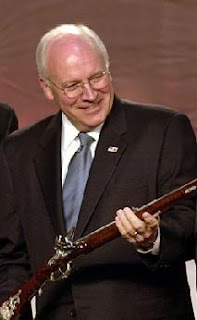
The steadily increasing national debt, now standing around $9 trillion is only the least of our problems. The concept itself is a quagmire, explainable only in jumbled economic jargon and a long discussion about modern monetary theory. But strip off all the bullshit and the idea is simple: we're using money that only kinda sorta actually exists on a material basis. And we're using lots and lots and lots of it. Since the advent of the Reagan revolution we've been trapped in a continuous reaffirmation of Keynesian insanity - the notion that supply-side economics was ever going to work is interminably couched in a system of privilege and inequality that knows no bounds. Giving to the poor by giving to the rich? Seriously?
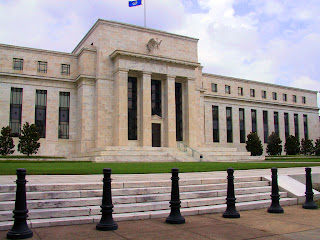
In the meantime, we've deregulated almost every industry, gutted the environmental reforms of the 1970s (which made us then, unlike now, a world leader on the subject), corporatized the media, opened the revolving door between Washington, K Street lobbies, interest groups, and the private sector, ruined Social Security and subverted the Health Care system, made a mockery of mental health and veterans benefits, clamped down on immigration while opening loopholes for immigrants' exploitation, and gotten to the point where the President can hand out military contracts to his buddies in the context of an un-endable, un-winnable, extremely profitable war. I think we're doing terribly, to be honest.

Add to this the fact that even the most astutely realist political scientists agree on the fact that China's economy will be larger than ours in the next fifty years and the fact that we currently operate on a 300 million dollar-a-year trade deficit with that country and the picture gets grimmer. India isn't far behind. What's left is an America trying to retain the world heavyweight belt by force instead of retiring gracefully and changing the nature of the sport. It's like we have the choice to be Ali or Tyson and instead of thinking it over we've bitten off the ears of everyone who even sniffs in our direction the wrong way. Instead of stepping down and encouraging mutual competition, we are the bully who has been outnumbered and continues to talk shit. And we all know what happens to that guy.
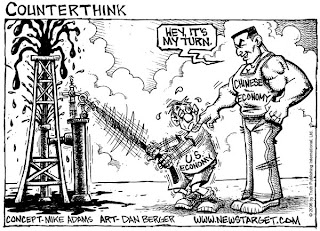
If we could only stop now and try to mend the mistakes of the past instead of rewriting the Monroe doctrine and stealing from third world countries in a last ditch attempt to line our pockets we might realize that there is something altogether more important at stake than being the world's strongest nation-state: being the world's smartest. Aside from the fact that kids in America are, on average, dumber and fatter than their European, Australian, and South American counterparts (do a little looking on this), the country as a whole is missing a great opportunity to use the last gasp of our cultural influence (America as a culture is still cool, apparently) to create a worldwide movement of tolerance and subsistence instead of division and consumption, we might just manage to tip the scales back to neutral, especially on the environmental question.

The nature of international politics, as any PoliSci professor over 50 will tell you, is anarchic, unpredictable and violent. But this assumes that politics and the international system have some specific nature that dictates them instead of realizing that the whole fucking discipline is less than a few hundred years old and that a lot has changed even in the last 20 years. Imagine an international politics that involves white kids and brown kids thousands of miles away playing the same videogames on a worldwide invisible network, talking to each other in real time as they interact in a virtual world. Fuck anarchic, this shit is incredible. In the context of a world where that goes on everyday, telling me that we didn't sign Kyoto because of differences in linguistic understanding and policy restrictions is a slap in the face. Why won't we act like normal human beings that live in a finite world for once? This is our children's future.
The simple answer is deafening and silencing at once, and it crushes the spirit of those of us who see more clearly (or perhaps more vaguely). The simple answer is that a few people are making a lot of money, and they don't want to stop making that much money. And what's worse, they can't be blamed. They live in a system that constantly requires them to preform a simple and never-ending task - make more money. And he we stand, faced with the realization that the system we live in is fundamentally opposed to our material reality, a reality that includes a dwindling oil supply, a skyrocketing debt, a mortgage and credit crisis, rampant poverty and unemployment, and a planet that is screaming at the top of its poisoned lungs for us to slow the fuck down. But the engines of the system are churning along full tilt, all cylinders firing, churning liquid capital out of the earth as the economy sucks in fresh dollars out of thin air.
Simple physics tells us that combustion engines need three things: fuel, air, and ignition. The system has plenty of sparks to go around - nationalism, the American dream, stuff upon stuff upon stuff. But what happens with the oil runs out and the mystical, airborne mint breathes its last dollar bill? We all seem to know the answer, somewhere between our hearts and our stomachs, and yet we remain defiant, our foot stamped on the accelerator as we grind down the gearbox, doing 95 in a 60 in 3rd gear. I hope we have the sense to hit the brakes before its too late. But right now, it looks like I'd better get ready to tuck and roll.
Since the abandonment of the gold standard during the era of New Deal reforms, the economy has been slipping steadily into an insurmountable hole, or debt and write-downs and outsourcing that is beginning to catch up with us. And we stand now poised at the precipice of a collapsing world financial infrastructure, looking straight down the barrel of a gun loaded with international fiscal ruin - and with Dick Cheney behind the sights that's a dangerous proposition. As far as I'm concerned, it might be the best thing that happens to humanity in my lifetime.

The steadily increasing national debt, now standing around $9 trillion is only the least of our problems. The concept itself is a quagmire, explainable only in jumbled economic jargon and a long discussion about modern monetary theory. But strip off all the bullshit and the idea is simple: we're using money that only kinda sorta actually exists on a material basis. And we're using lots and lots and lots of it. Since the advent of the Reagan revolution we've been trapped in a continuous reaffirmation of Keynesian insanity - the notion that supply-side economics was ever going to work is interminably couched in a system of privilege and inequality that knows no bounds. Giving to the poor by giving to the rich? Seriously?

In the meantime, we've deregulated almost every industry, gutted the environmental reforms of the 1970s (which made us then, unlike now, a world leader on the subject), corporatized the media, opened the revolving door between Washington, K Street lobbies, interest groups, and the private sector, ruined Social Security and subverted the Health Care system, made a mockery of mental health and veterans benefits, clamped down on immigration while opening loopholes for immigrants' exploitation, and gotten to the point where the President can hand out military contracts to his buddies in the context of an un-endable, un-winnable, extremely profitable war. I think we're doing terribly, to be honest.

Add to this the fact that even the most astutely realist political scientists agree on the fact that China's economy will be larger than ours in the next fifty years and the fact that we currently operate on a 300 million dollar-a-year trade deficit with that country and the picture gets grimmer. India isn't far behind. What's left is an America trying to retain the world heavyweight belt by force instead of retiring gracefully and changing the nature of the sport. It's like we have the choice to be Ali or Tyson and instead of thinking it over we've bitten off the ears of everyone who even sniffs in our direction the wrong way. Instead of stepping down and encouraging mutual competition, we are the bully who has been outnumbered and continues to talk shit. And we all know what happens to that guy.

If we could only stop now and try to mend the mistakes of the past instead of rewriting the Monroe doctrine and stealing from third world countries in a last ditch attempt to line our pockets we might realize that there is something altogether more important at stake than being the world's strongest nation-state: being the world's smartest. Aside from the fact that kids in America are, on average, dumber and fatter than their European, Australian, and South American counterparts (do a little looking on this), the country as a whole is missing a great opportunity to use the last gasp of our cultural influence (America as a culture is still cool, apparently) to create a worldwide movement of tolerance and subsistence instead of division and consumption, we might just manage to tip the scales back to neutral, especially on the environmental question.

The nature of international politics, as any PoliSci professor over 50 will tell you, is anarchic, unpredictable and violent. But this assumes that politics and the international system have some specific nature that dictates them instead of realizing that the whole fucking discipline is less than a few hundred years old and that a lot has changed even in the last 20 years. Imagine an international politics that involves white kids and brown kids thousands of miles away playing the same videogames on a worldwide invisible network, talking to each other in real time as they interact in a virtual world. Fuck anarchic, this shit is incredible. In the context of a world where that goes on everyday, telling me that we didn't sign Kyoto because of differences in linguistic understanding and policy restrictions is a slap in the face. Why won't we act like normal human beings that live in a finite world for once? This is our children's future.

The simple answer is deafening and silencing at once, and it crushes the spirit of those of us who see more clearly (or perhaps more vaguely). The simple answer is that a few people are making a lot of money, and they don't want to stop making that much money. And what's worse, they can't be blamed. They live in a system that constantly requires them to preform a simple and never-ending task - make more money. And he we stand, faced with the realization that the system we live in is fundamentally opposed to our material reality, a reality that includes a dwindling oil supply, a skyrocketing debt, a mortgage and credit crisis, rampant poverty and unemployment, and a planet that is screaming at the top of its poisoned lungs for us to slow the fuck down. But the engines of the system are churning along full tilt, all cylinders firing, churning liquid capital out of the earth as the economy sucks in fresh dollars out of thin air.

Simple physics tells us that combustion engines need three things: fuel, air, and ignition. The system has plenty of sparks to go around - nationalism, the American dream, stuff upon stuff upon stuff. But what happens with the oil runs out and the mystical, airborne mint breathes its last dollar bill? We all seem to know the answer, somewhere between our hearts and our stomachs, and yet we remain defiant, our foot stamped on the accelerator as we grind down the gearbox, doing 95 in a 60 in 3rd gear. I hope we have the sense to hit the brakes before its too late. But right now, it looks like I'd better get ready to tuck and roll.
Wednesday, December 12, 2007
Democracy of Misrepresentation
Stop trying to figure out who's going to win the election this year. It doesn't matter.
As of right now, the imperialist swine that dictate campaign finance and strategy (read: Karl Rove) have your nuts in a fucking vicegrip. The democracy has been taken over by the hegemony of propaganda. You no longer control your own destiny.
It may sound like a bit much, but the truth remains: the voters are now, more than ever, a market to be cornered instead of served. Manipulation of media and word wars between Yale-educated system pawns dictate the flow of information, deciding what voters see, hear, think. And while the YouTube debates are certainly a step in the right direction, for the most part we are doomed to live in the blackhole of reliance on mainstream media instead of the golden age of oration. We have little or no idea what any of these candidates will do once in office, and we must realize the limiting factors of the office itself. A President, though influential, cannot change the system.
A bunch of old white guys still make laws for a country that is harly old, or white, or male. The representative democracy the United States has always claimed has always been a democracy of representation - representation of freedom, of wealth, of equality. But on the ground these things take on different guises and meanings, become entirely different things. Tell a businessman in the suburbs he's a free man and he'll tell you he knows; tell a migrant worker in Texas the same thing and he'll scowl at your hubris. Policy and politics and language mean nothing on the ground, and the beat of work and of the sun reminds our worker just how far from Washington he is, and just how far Washington is from him.
The unspoken arrangement of politics in this country is simple: we know better than you. We know the way the world works, we know the how to manipulate it, we know what's best for America. We know because we are white, and male, and rich. We know because we sat in classrooms and listened to people like us. We know because we got jobs working for people like us. And we know because of the money we've made off of people like you.
Make no doubt about it, the power elites understand this relationship. Politicians know that their power is couched in the denial of agency. CEO's know their fortune is couched in the exploitation of labor. And oil companies know their future is couched in the rape of the environment. They understand the way their world works - as a zero sum game. One up means one down, and more often two or three or ten down.
So as you watch this election season, perhaps the most ridiculous of all time, remember that you are a target. You are a consumer, a piece of the market to be cornered and exploited. You are put into groups based on race and gender and class and religion; a demographic and a number and nothing near a human being. Whether you purchase Romney or Clinton or Guiliani or Obama or, God willing, Huckabee, remind yourself that your vote comes at a price. And if you choose to be apathetic, at least do so with passion.
As of right now, the imperialist swine that dictate campaign finance and strategy (read: Karl Rove) have your nuts in a fucking vicegrip. The democracy has been taken over by the hegemony of propaganda. You no longer control your own destiny.
It may sound like a bit much, but the truth remains: the voters are now, more than ever, a market to be cornered instead of served. Manipulation of media and word wars between Yale-educated system pawns dictate the flow of information, deciding what voters see, hear, think. And while the YouTube debates are certainly a step in the right direction, for the most part we are doomed to live in the blackhole of reliance on mainstream media instead of the golden age of oration. We have little or no idea what any of these candidates will do once in office, and we must realize the limiting factors of the office itself. A President, though influential, cannot change the system.
A bunch of old white guys still make laws for a country that is harly old, or white, or male. The representative democracy the United States has always claimed has always been a democracy of representation - representation of freedom, of wealth, of equality. But on the ground these things take on different guises and meanings, become entirely different things. Tell a businessman in the suburbs he's a free man and he'll tell you he knows; tell a migrant worker in Texas the same thing and he'll scowl at your hubris. Policy and politics and language mean nothing on the ground, and the beat of work and of the sun reminds our worker just how far from Washington he is, and just how far Washington is from him.
The unspoken arrangement of politics in this country is simple: we know better than you. We know the way the world works, we know the how to manipulate it, we know what's best for America. We know because we are white, and male, and rich. We know because we sat in classrooms and listened to people like us. We know because we got jobs working for people like us. And we know because of the money we've made off of people like you.
Make no doubt about it, the power elites understand this relationship. Politicians know that their power is couched in the denial of agency. CEO's know their fortune is couched in the exploitation of labor. And oil companies know their future is couched in the rape of the environment. They understand the way their world works - as a zero sum game. One up means one down, and more often two or three or ten down.
So as you watch this election season, perhaps the most ridiculous of all time, remember that you are a target. You are a consumer, a piece of the market to be cornered and exploited. You are put into groups based on race and gender and class and religion; a demographic and a number and nothing near a human being. Whether you purchase Romney or Clinton or Guiliani or Obama or, God willing, Huckabee, remind yourself that your vote comes at a price. And if you choose to be apathetic, at least do so with passion.
Sunday, September 30, 2007
Less Decadent, More Depraved : NASCAR and The Great American Spectacle
So we're allmost out of oil. And carbon emmissions from petroleum burning engines are destroying the environment. But we're America, so we do the only logical thing: we build 800 horsepower, fuel guzzling racecars, and have them chase each other around a glorified hampster wheel for 400 laps at a time. We do it every weekend (3 times every weekend, actually), and 150,000 people come to watch.
That's three colliseums' worth of people - and the comparison is no mistake. In many ways the NASCAR phenomenon is akin to the spectacles of ancient Rome, spectacles where human life was regularly destroyed in the name of visceral entertainment. While the possibility of death, or at least the anticipation of disastrous high-speed collisions, is certainly a major draw for many fans, the sacrifice in NASCAR comes from the bosom of of Mother Nature. By most accounts, an average NASCAR series season comsumes about 200,000 gallons of fuel. This figure excludes practice, qualifying, and tuning, all of which undoubtedly inflate it considerably. The consumption itself is staggering, to be sure, but the rate at which these machines suck down gas is matched in intensity only by the jet-engine-level noise they throw into the atmosphere. The shit is loud. Really loud. Ears-bleeding, eyeballs-bulging, rib-shaking loud.
In fact, the experience of the racetrack is blistering for all five senses. Not only is your auditory capacity at the complete mercy of these massive, churning dynamos, the smell of burning rubber and Marlboros stuffs your nostrils, the cold, damp touch of a sweating Budweiser can preoccupies he fingers. And then the sights - oh the sights! Jean shorts and flame-tagged hats, no-name hightops and decaled pickups, meth addicts, swingers, smokers, mullets, spare rib and hamburger profilgacy, small children and old ladies, beer bellies and big titties, booze upon booze upon booze upon booze, more booze, a strikingly high number of full families, and a surprisingly low contingent of police. And caucasia everywhere.
They are 150,000 pilgrims to the high altar of motorsports, and on sunny Sunday sabbaths they trade in church for, as one pre-event prayer read, "racing in the name of Jesus Christ, the way God intended." And for many the spectacle is nothing short of a religious happening. Mom, Dad, and Grandma show up in the RV on Thursday night, watch qualifying, the truck race, the Busch race, and then gear up for the main event, the consecration of the entire ceremony, the culminating act of the whole shebang: the Nextel race.
Nextel races draw, on average, more spectators than for any other major sport in the United States. They command the second position, behind NFL football, in the television ratings battle. And watching a race, either in person or on that magical talking box Americans love so much, one is exposed to unparalleled volume of corporate sponsorship. Alcohol manufacturers, car insurance dealers, office suppliers, home-improvement stores, and even the US National Guard claim primary sponsorship of a Nextel car, a billion dollar a year commitment. Their logos displayed prominently on all sides of the vehicle, creating a permanent, three-hour long TV spot and a mobile billboard at the same time. Merchandise sales routinely top $2 billion annually, everything from model cars to clothing to furniture.

So why do they come? Why do these people tune in and turn out 40 weeks of the year to this fuel-wasting, environment draining, consumerism-inciting spectacle of excess and incest? They do it because the human animal is addicted to entertainment, compelled naturally toward the possibility of destruction, still governed, at some level, by the craving for viceral stimuli. And Goddamn it, dem cars go real fast.

That's three colliseums' worth of people - and the comparison is no mistake. In many ways the NASCAR phenomenon is akin to the spectacles of ancient Rome, spectacles where human life was regularly destroyed in the name of visceral entertainment. While the possibility of death, or at least the anticipation of disastrous high-speed collisions, is certainly a major draw for many fans, the sacrifice in NASCAR comes from the bosom of of Mother Nature. By most accounts, an average NASCAR series season comsumes about 200,000 gallons of fuel. This figure excludes practice, qualifying, and tuning, all of which undoubtedly inflate it considerably. The consumption itself is staggering, to be sure, but the rate at which these machines suck down gas is matched in intensity only by the jet-engine-level noise they throw into the atmosphere. The shit is loud. Really loud. Ears-bleeding, eyeballs-bulging, rib-shaking loud.
In fact, the experience of the racetrack is blistering for all five senses. Not only is your auditory capacity at the complete mercy of these massive, churning dynamos, the smell of burning rubber and Marlboros stuffs your nostrils, the cold, damp touch of a sweating Budweiser can preoccupies he fingers. And then the sights - oh the sights! Jean shorts and flame-tagged hats, no-name hightops and decaled pickups, meth addicts, swingers, smokers, mullets, spare rib and hamburger profilgacy, small children and old ladies, beer bellies and big titties, booze upon booze upon booze upon booze, more booze, a strikingly high number of full families, and a surprisingly low contingent of police. And caucasia everywhere.

They are 150,000 pilgrims to the high altar of motorsports, and on sunny Sunday sabbaths they trade in church for, as one pre-event prayer read, "racing in the name of Jesus Christ, the way God intended." And for many the spectacle is nothing short of a religious happening. Mom, Dad, and Grandma show up in the RV on Thursday night, watch qualifying, the truck race, the Busch race, and then gear up for the main event, the consecration of the entire ceremony, the culminating act of the whole shebang: the Nextel race.
Nextel races draw, on average, more spectators than for any other major sport in the United States. They command the second position, behind NFL football, in the television ratings battle. And watching a race, either in person or on that magical talking box Americans love so much, one is exposed to unparalleled volume of corporate sponsorship. Alcohol manufacturers, car insurance dealers, office suppliers, home-improvement stores, and even the US National Guard claim primary sponsorship of a Nextel car, a billion dollar a year commitment. Their logos displayed prominently on all sides of the vehicle, creating a permanent, three-hour long TV spot and a mobile billboard at the same time. Merchandise sales routinely top $2 billion annually, everything from model cars to clothing to furniture.

So why do they come? Why do these people tune in and turn out 40 weeks of the year to this fuel-wasting, environment draining, consumerism-inciting spectacle of excess and incest? They do it because the human animal is addicted to entertainment, compelled naturally toward the possibility of destruction, still governed, at some level, by the craving for viceral stimuli. And Goddamn it, dem cars go real fast.
Thursday, June 7, 2007
To: Anonymous - From: The Kids
From the kids of the street:
Fuck you nigga.
You heard me.
Fuck you, Nigga.
Wow nigga
how nigga
now nigga
tell me how i'm supposed to rise above the violence and strife
when the smell around me cuts like a knife
when none of the my brothers' fathers call my mother their wife
when the game pins my ambition tight like a vice
tell me how i'm supposed to live my life.
school's out prison's in
it's where i'll find my closest of kin
doin time in the joint for smokin' a joint
mothafuckas i know you got my point man
held up in cuffs like scotland yard
playin' the trump card; rat
me out i'm beggin you please
my homies'll have screamin 'don't' from your knees
just be thankful i'm smokin' those trees
make 5.50 to work, lose 10 from welfare
you do the math like sebastian telfar,
couldn't count the numbers on the fuckin' contract
even if he could make the shot after contact.
so hedge fund your bets trustfunders
and let the system pull me under
pregnant by 15, addicted at 20, dead at 40,
damn sure MY record never made no royalties
still holdin tight in my pocket to my false sense of loyalty
to the streets.
so fuck you nigga.
you heard me.
fuck you, nigga
- the youth
Fuck you nigga.
You heard me.
Fuck you, Nigga.
Wow nigga
how nigga
now nigga
tell me how i'm supposed to rise above the violence and strife
when the smell around me cuts like a knife
when none of the my brothers' fathers call my mother their wife
when the game pins my ambition tight like a vice
tell me how i'm supposed to live my life.
school's out prison's in
it's where i'll find my closest of kin
doin time in the joint for smokin' a joint
mothafuckas i know you got my point man
held up in cuffs like scotland yard
playin' the trump card; rat
me out i'm beggin you please
my homies'll have screamin 'don't' from your knees
just be thankful i'm smokin' those trees
make 5.50 to work, lose 10 from welfare
you do the math like sebastian telfar,
couldn't count the numbers on the fuckin' contract
even if he could make the shot after contact.
so hedge fund your bets trustfunders
and let the system pull me under
pregnant by 15, addicted at 20, dead at 40,
damn sure MY record never made no royalties
still holdin tight in my pocket to my false sense of loyalty
to the streets.
so fuck you nigga.
you heard me.
fuck you, nigga
- the youth
Wednesday, May 23, 2007
Why Hip-Hop Is Better Than Government
Spits straight, gains weight, won't take your claim, shit on your game, take aim at your will.
No, hip-hop won't hate, won't comiserate with these fools at the gates with these cats, straight house cats not wiling to go and see the results of their elite complicity, the ghettos full of kids left behind and junkies in a bind, sleepin' on the streets while the politicians' daughters win track meets.
Hip-hop can't classify, identify, indemnify the causes of the american poverty, the highs in white houses spitting lies at black faces, forgetting the truth about people in places, constantly avoiding all incriminating traces, denying different races play a role when the dark-skinned ones are the only ones that they stole.
Hip-hop won't judge and won't budge, holds deserved grudges and has its own judges, taking cases to street over soul-inspired beats, speaks to those who listen and listens to those that speak, evolves of the mind and never abandons the grind, working hard for effortless flows, from the cypher to the show, takes you as you come and may never let you go.
Hip-hop is the meditation of the mind, a divine contraception of ideas and reception, the confluence of lessons learned in long private sessions, with friends and L's moving in procession to the beat, the beat, the beat of impression that never preaches down to the masses but comes up with the grasses between the concrete blocks of the world that walks.
Hip-hop don't charge taxes, it relaxes, the body and mind at the same pace, sayin' grace to the pioneers of street lure and emcees of rap galore, spreading the rhetoric of a new asthetic in rhymes and sayin' fuck it to the times, fuck it to the lines of propaganda bullshit, fuck it to the last of this too long BUSH-shit, fuck it to the congress and courts that try to save, all they've done is re-enslave.
Hip-hop is better than government.
No, hip-hop won't hate, won't comiserate with these fools at the gates with these cats, straight house cats not wiling to go and see the results of their elite complicity, the ghettos full of kids left behind and junkies in a bind, sleepin' on the streets while the politicians' daughters win track meets.
Hip-hop can't classify, identify, indemnify the causes of the american poverty, the highs in white houses spitting lies at black faces, forgetting the truth about people in places, constantly avoiding all incriminating traces, denying different races play a role when the dark-skinned ones are the only ones that they stole.
Hip-hop won't judge and won't budge, holds deserved grudges and has its own judges, taking cases to street over soul-inspired beats, speaks to those who listen and listens to those that speak, evolves of the mind and never abandons the grind, working hard for effortless flows, from the cypher to the show, takes you as you come and may never let you go.
Hip-hop is the meditation of the mind, a divine contraception of ideas and reception, the confluence of lessons learned in long private sessions, with friends and L's moving in procession to the beat, the beat, the beat of impression that never preaches down to the masses but comes up with the grasses between the concrete blocks of the world that walks.
Hip-hop don't charge taxes, it relaxes, the body and mind at the same pace, sayin' grace to the pioneers of street lure and emcees of rap galore, spreading the rhetoric of a new asthetic in rhymes and sayin' fuck it to the times, fuck it to the lines of propaganda bullshit, fuck it to the last of this too long BUSH-shit, fuck it to the congress and courts that try to save, all they've done is re-enslave.
Hip-hop is better than government.
Thursday, April 26, 2007
The New Democracy: Government on the People, at the Cost of the People.

Get out the champagne, crack that bottle you've been holding on to, smoke that secret stash you've been saving. I figured it out. I figured out how to fix Iraq.
1). Invade the country for no reason, with no evidence, and with a wafer-thin authorization from Congress.
2). Create a Public Relations campaign the likes of which America has never seen; a propaganda circus that includes fake news, embedded censorship, and an unrelenting assault of false statements.
3). Proclaim a premature victory to rouse nationalism against the barbarians.
4). Send a whole bunch of able-bodied American men to be killed. (But try to take the poor, the brown, the uneducated, marginalized. We never liked the fuckers anyways.)
5) Award billions of dollars of military contracts to your buddies. Cuz fuck 'em, why not?
6). Try to institute a democratic, power-sharing government in a country that has never seen power-sharing, democracy, or government. Oh, and we destroyed the entire infrastructure. No more moads, policing, sewers, drinking water, airports, banking. Our bad. But hey, more contracts for your buddies.
7). When the American people find out what's going on, silence the dissenters. If the war is good against evil, only the hippies will pick evil. And remember, God Loves the Patriot Act.
8). Build a wall in the middle of Baghdad to separate the two sides. We know building walls to separate people works really well. Just look at Germany, Palestine, and Northern Ireland.
9). Fight to the death to keep the troops in Iraq, to the point of absurdity. 3,000 are already dead, what's another 500? Americans won't remember in five years anyways, right?
10). Get the hell out of dodge. Go find yourself a nice ranch in Texas. Smoke those Cubans the CIA stole from Fidel, blow that coke you extorted from the Medellin, drink that bottle of vodka you scammed from Putin and the Scotch Tony Blair gave you to let him suck you off. And while you're at it, fuck that 15 year-old virgin the bin-Ladens gave you to 'make this whole thing go away.'
What's that you say? It didn't work? Iraq is still a disaster? Well, fuck 'em. You're rich.
Monday, April 23, 2007
An Audience of One
From the start, let it be clear that any undue loss of life, no matter how small or large, is a crime and a tragedy. To force someone else to unwillingly lose their life is to rob them of their future children, their future loves, their future professions, their future hopes and aspirations - in short, the future.
So when we come face to face with death on such a large scale as the recent events at Virginia Tech, we must, absolutely, take pause to reflect upon the state of a world that allows such things to go on. We must examine the structures that support a worldview like the one that caused the death of 32 innocent students. And of course, we must grieve over the loss of a pool of human resources so wide and deep it can never be recreated. But in this reflection we must be honest about the ways of the world and try to look at the underlying causes and power structures that harbor violence within their ideological walls.
As the media coverage has rolled on, nearly ubiquitously, the solutions to problems like this have been simple: increase security, provide counseling, try to screen for disturbed youth. In short, the answer has been more guns, not less. The answer has been to increase security, not to decrease hate. The answer, American as America gets, is more and more and more instead of simply better. And as the media continues to broadcast from Virginia Tech and continues to show the manifesto tape of the killer, we are confronted with yet another truth: this is exactly what he wanted.
The shooter credits the two young men from Columbine High School as "martyrs" in his taped remarks, a sign of the increasing allegiance to violence as the means of escape from a culture of hate and degradation that follows many adolescents. What made this student so angry was the affluence and entitlement that surrounded him, the feeling of unnacceptance that comes with being a brown person in a white country, the sense that everyone around him was the recipient of a divine grace that he missed. In short, he was seduced by the great American myth of more and not better, unaware that many of the affluent and entitled students he was seeing through angry eyes were the victims of the same dissafection.
But the point here is that he had a model to follow. Columbine, as the firestarter that ignited a trend of school shootings, painted a picture of the rebels that stuck in the minds of others. All over the country, students from high school to elementary school were bombarded by the images of the two shooters in trenchcoats, enacting their revenge upon the popular, the wealthy, the entitled, the authorities. All over the country, students watched blueprints and timelines and examined every aspect of the incident, from the weapons technology to the manifesto to Marilyn Manson. And suddenly, all over the country, students who felt the same way had an example.
As we are faced with a tragedy that matches Columbine in scale, why are we doing the same things? Instead of diagramming the hallways and remarking the shooter's expert marksmanship, why are we not interviewing students who aren't letting this violence affect their lives? Why, instead of silencing the voice of violent oppression, are we giving it primetime media coverage. The end message is this: "if you feel silenced, or oppressed, or disenfranchised, and you want to do something about it, violence will give you a voice. Violence will lead the way. Violence will help you reach an audience of half a billion people." Thirty-two students later, this shooter got what he wanted all along: a voice.
By all means, we must protect ourselves. But we must do so in the manner that makes the most sense: by listening. There are other student out there who are watching and learning, others who feel the way this student did. And though there is a difference between feeling and action, that difference can be erased by a single hateful comment, a single act of ignorance or malice.
So in honor of the fallen students, and in hope for the future, turn off your television and open your eyes and ears. With an honest desire to listen and learn instead of fear and loathe, you might just stop the shooting.
So when we come face to face with death on such a large scale as the recent events at Virginia Tech, we must, absolutely, take pause to reflect upon the state of a world that allows such things to go on. We must examine the structures that support a worldview like the one that caused the death of 32 innocent students. And of course, we must grieve over the loss of a pool of human resources so wide and deep it can never be recreated. But in this reflection we must be honest about the ways of the world and try to look at the underlying causes and power structures that harbor violence within their ideological walls.
As the media coverage has rolled on, nearly ubiquitously, the solutions to problems like this have been simple: increase security, provide counseling, try to screen for disturbed youth. In short, the answer has been more guns, not less. The answer has been to increase security, not to decrease hate. The answer, American as America gets, is more and more and more instead of simply better. And as the media continues to broadcast from Virginia Tech and continues to show the manifesto tape of the killer, we are confronted with yet another truth: this is exactly what he wanted.
The shooter credits the two young men from Columbine High School as "martyrs" in his taped remarks, a sign of the increasing allegiance to violence as the means of escape from a culture of hate and degradation that follows many adolescents. What made this student so angry was the affluence and entitlement that surrounded him, the feeling of unnacceptance that comes with being a brown person in a white country, the sense that everyone around him was the recipient of a divine grace that he missed. In short, he was seduced by the great American myth of more and not better, unaware that many of the affluent and entitled students he was seeing through angry eyes were the victims of the same dissafection.
But the point here is that he had a model to follow. Columbine, as the firestarter that ignited a trend of school shootings, painted a picture of the rebels that stuck in the minds of others. All over the country, students from high school to elementary school were bombarded by the images of the two shooters in trenchcoats, enacting their revenge upon the popular, the wealthy, the entitled, the authorities. All over the country, students watched blueprints and timelines and examined every aspect of the incident, from the weapons technology to the manifesto to Marilyn Manson. And suddenly, all over the country, students who felt the same way had an example.
As we are faced with a tragedy that matches Columbine in scale, why are we doing the same things? Instead of diagramming the hallways and remarking the shooter's expert marksmanship, why are we not interviewing students who aren't letting this violence affect their lives? Why, instead of silencing the voice of violent oppression, are we giving it primetime media coverage. The end message is this: "if you feel silenced, or oppressed, or disenfranchised, and you want to do something about it, violence will give you a voice. Violence will lead the way. Violence will help you reach an audience of half a billion people." Thirty-two students later, this shooter got what he wanted all along: a voice.
By all means, we must protect ourselves. But we must do so in the manner that makes the most sense: by listening. There are other student out there who are watching and learning, others who feel the way this student did. And though there is a difference between feeling and action, that difference can be erased by a single hateful comment, a single act of ignorance or malice.
So in honor of the fallen students, and in hope for the future, turn off your television and open your eyes and ears. With an honest desire to listen and learn instead of fear and loathe, you might just stop the shooting.
Subscribe to:
Posts (Atom)